
Hotel SOP development and staff training in Cyprus should make daily work clearer. HoHo Consultancy helps your team turn service standards into practical procedures, shift checklists and role-based training.

Our SOP development and staff training service supports hotel owners, operators and department managers in Cyprus who need clearer everyday working procedures. It can suit a new opening, an established property with inconsistent routines or a business preparing to train additional teams.
You may need support when instructions differ between shifts, supervisors repeatedly answer the same questions or important tasks depend on knowledge held by only a few employees. The review starts with the actual work and the people carrying it out. We identify which procedures need attention first and which existing documents remain useful.
The scope can cover reception, housekeeping, food and beverage, maintenance coordination and management routines. Each procedure should identify its purpose, responsible roles, task sequence, expected result and escalation route. Training gives staff an opportunity to practise and show where instructions are unclear.
SOP development should fit the property’s layout, systems and resources. Digital checklists may help some workflows, while others need a simpler approach. We can connect the work with hotel digitalisation where appropriate, or with pre-opening and development planning when procedures are being prepared for a new operation. The agreed deliverables and review responsibilities are documented before rollout.

We begin SOP development by reviewing how tasks are currently carried out. Existing documents, staff feedback and practical observations help identify where instructions differ, handovers fail or responsibilities are unclear. The review recognises procedures that already work and should be retained.
Management agrees the first priorities according to the property’s needs. A task affecting room readiness may require a different response from a document-control issue or an unclear purchasing approval. We identify the people who need to contribute and the evidence needed to understand the problem.
The output is a procedure register with priorities, owners and questions to resolve. Where useful measurements are available, we record their definitions and limitations before choosing a baseline. This keeps SOP development focused on actual operating requirements instead of producing a generic manual that has not been tested against the hotel’s work.
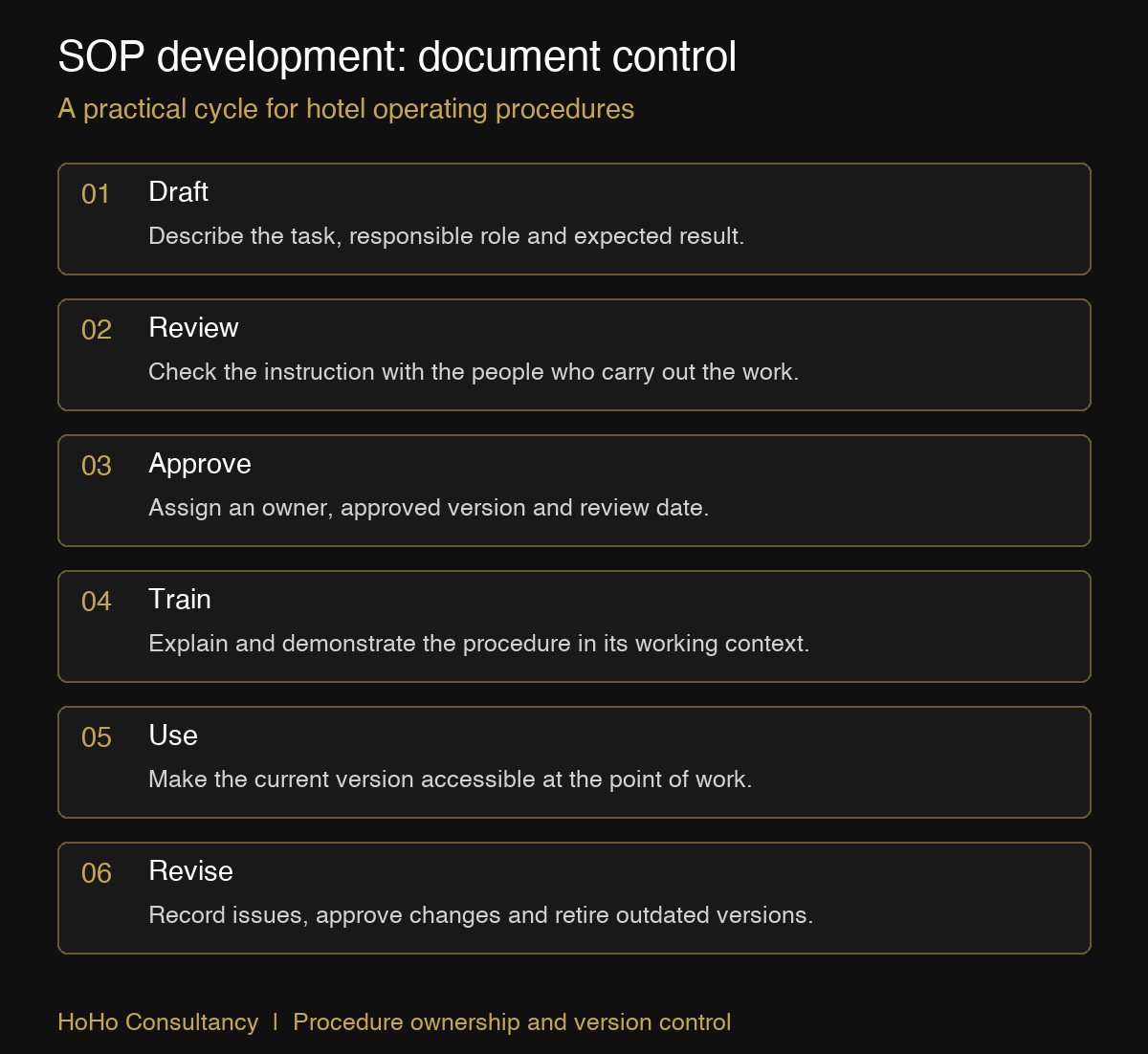
Each procedure needs a consistent structure that helps staff find the instruction they need. Our SOP development work defines the purpose, scope, responsible roles, task sequence, expected result and escalation route. A document should also show its owner and current approved version.
Department procedures are organised around the property’s operating model. Reception, housekeeping, food and beverage and maintenance may need different forms, but shared handovers must use compatible information. We identify where one department’s task creates a responsibility for another.
Drafts are reviewed with the people expected to use them. Technical or regulated content requires appropriate specialist input, and the hotel’s own approval remains essential. The objective is a navigable procedure library with clear ownership and practical instructions. It should be understandable to the intended users and maintainable when equipment, systems or service requirements change.
A procedure explains the work; a checklist helps record the relevant checks. SOP development should distinguish those purposes so employees do not have to interpret a tick box as a complete instruction. We select the supporting tools needed for the agreed routines.
Examples include shift handovers, room inspection records, maintenance reports and incident follow-up logs. Each tool should identify who completes it, where it is stored and who acts on an exception. Collecting information without a review responsibility creates paperwork without a clear operational use.
Tools can be digital or paper-based depending on the property’s systems and working conditions. Where digital coordination is useful, the project can connect with hotel workflow digitalisation. We test the format with staff and remove unnecessary duplication. The final package includes instructions for use and responsibility for keeping the tools current.
Great SOPs only work when they are operationally embedded. That’s why we translate the playbooks into daily tools that drive real behaviour: shift checklists, task boards, handover templates, incident logs, cleaning inspection forms, stock par sheets, maintenance tickets, and supervisor audit routines.
Training translates SOP development into practical learning. We identify what each role needs to understand, which tasks require demonstration and where supervised practice is appropriate. The training plan reflects the team’s experience, language needs and available time.
Learning can combine explanation, demonstration, practice and feedback. Supervisors need clear criteria for observing a task and recording further support needs. A completed attendance sheet shows participation, not necessarily the ability to perform every task independently.
The plan also identifies who will train future employees and where the approved materials are stored. Training responsibilities should remain realistic alongside daily service. Any certification, regulated training or funding requirement is checked separately before it is offered. The agreed deliverable is a practical learning structure and usable supporting records, with the hotel responsible for ongoing supervision and appropriate specialist requirements.
The following sequence provides a starting point for a supervisor-led practice session. Adapt it to the task and the employee’s support needs.
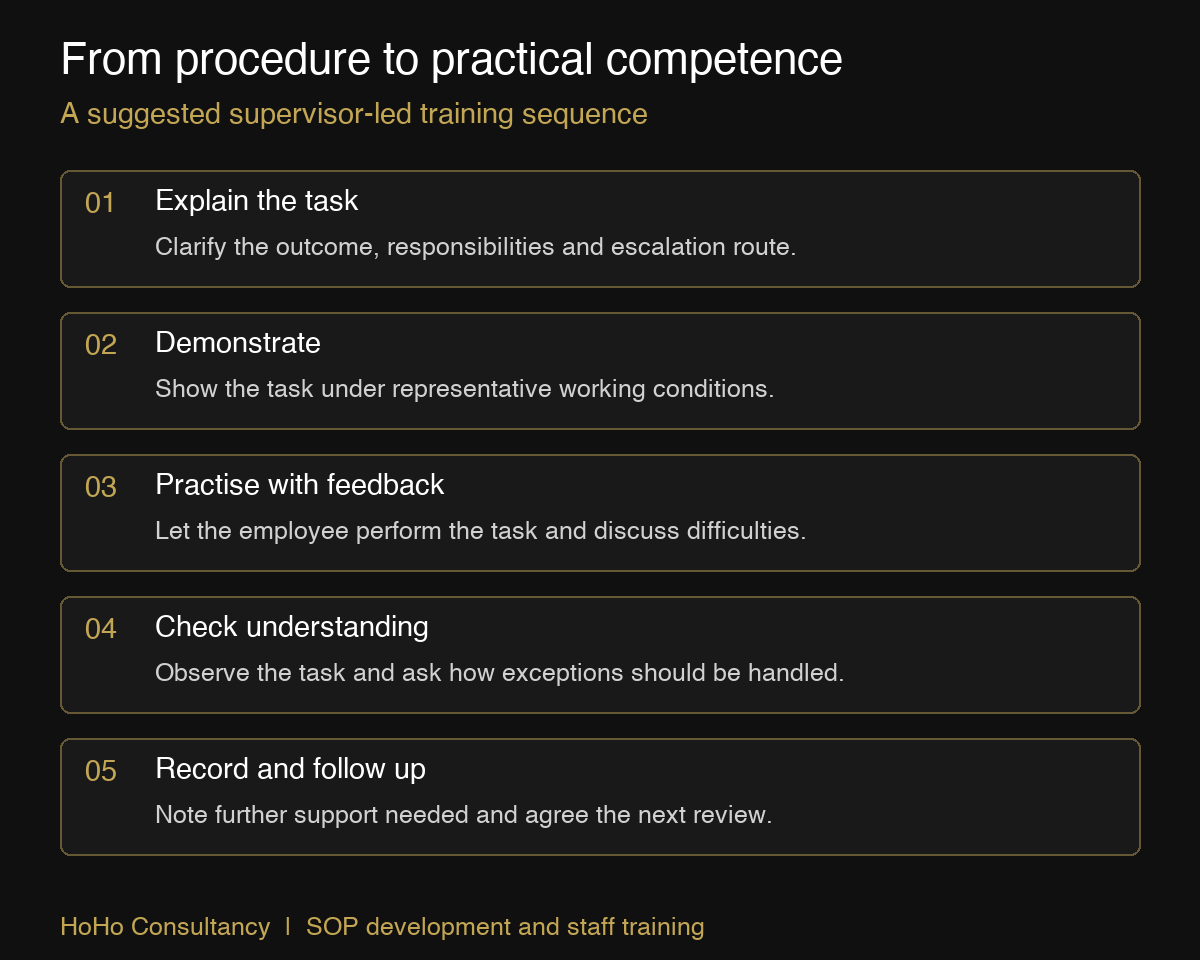
For example, when practising a room-readiness handover, ask the employee to describe the normal sequence and explain who should receive an unresolved defect. Observe the handover in practice, discuss any difficulty and record the further support required. Keep the training record proportionate to the task.
Before extending a new procedure across the hotel, we test it in the conditions where it will be used. SOP development should allow staff to identify missing steps, unclear language or instructions that conflict with the layout and available equipment.
The rollout is agreed with department managers so learning and observation can take place alongside service. We record practical exceptions and decide whether the procedure, the supporting tool or the training needs adjustment. Changes are approved before the revised version is distributed.
Supervisors then use the agreed checks to observe application and provide feedback. The project records which teams have received the update and which actions remain open. This creates a controlled implementation process without promising immediate financial gains. The pace depends on the number of procedures, operational workload and the capacity available for training and review.
The final part of SOP development establishes how procedures will remain useful after the assignment. Management agrees document owners, review dates and approval responsibilities. Staff should know where the current version is held and how to report an instruction that no longer fits the work.
A practical review considers observed exceptions, changes in equipment or systems and the information needed to assess the routine. Measures should support a decision rather than simply increase reporting. Where a result changes, the team investigates the cause before attributing it to training alone.
The handover includes the procedure register, supporting tools, training records and unresolved questions within the agreed scope. Ongoing coordination can link to head office support if required. The hotel retains responsibility for maintaining its standards and obtaining specialist review where legal, safety or technical requirements apply.
SOP development turns agreed operating standards into instructions the team can use. Staff training supports practical application, while supervisors review exceptions and keep procedures aligned with the way the hotel operates.
Give each shift clear task instructions, responsibilities and a route for handling exceptions.
Plan role-specific learning and supervised practice before staff carry out tasks independently.
Translate the hotel’s guest promise into practical instructions and observable checks.
Define who performs each task, who checks it and when an issue needs escalation.
Keep procedures current with named owners, approval dates and an accessible version history.
Record training, practical observations and follow-up needs using tools supervisors can maintain.
Develop clear procedures and role-specific training that supervisors can use in daily operations.
Adapt the work to your Cyprus property’s layout, team, systems and guest offer.
Agree document ownership, review dates and a practical handover for ongoing maintenance.
Answers about SOP development, practical training and maintaining hotel procedures. For workplace safety context, EU-OSHA’s risk assessment guidance explains how information, training and preventive measures fit together. Property-specific safety requirements need appropriate specialist review.
SOP development means creating and maintaining standard operating procedures for defined tasks. In a hotel, a procedure might explain a shift handover, room inspection, maintenance report or guest request process. It identifies responsibilities, the steps to follow and what to do when an exception occurs.
Staff training supports practical use of those instructions through explanation, demonstration, practice and feedback. The two activities should be connected: a document that employees cannot understand or apply needs revision. We agree the scope with management and adapt the procedures to the property’s layout, systems and service requirements.
The service can support hotel owners, operators and department managers in Cyprus who need clearer routines and a more structured approach to training. It may be relevant before an opening, when existing documents are inconsistent or when additional employees need to learn the same tasks.
We first review the property’s priorities and the time available for implementation. Not every hotel needs a complete procedure library rebuilt. A focused SOP development assignment may address a few important handovers or department routines. The scope should reflect the decisions management needs to make and the work its team can maintain.
The scope can include reception, housekeeping, food and beverage, maintenance coordination and management routines. Examples include room readiness checks, shift handovers, guest request follow-up, purchasing approvals and the handling of operating exceptions. We agree the procedure list before drafting.
SOP development should also identify where one department depends on another. A maintenance report, for example, needs a response and a way to communicate the room’s status. Technical, safety or regulated instructions require appropriate specialist input; a general operating procedure does not replace that expertise. Management reviews and approves the final instructions before rollout.
The timetable depends on the number and complexity of procedures, the quality of existing documents and staff availability for review and practice. We agree milestones for drafting, testing, training and handover rather than promising the same completion period for every property.
Early progress might be an approved handover template or a completed practical trial. That is different from proving a change in productivity or guest satisfaction. SOP development results should be assessed over a suitable period with consistent measures where available. The plan also needs time for feedback and revisions when the team discovers an instruction that does not fit daily work.
Good procedures clarify the parts of service that need consistency while identifying where staff can exercise judgement. An instruction can define how to record a guest request and when to involve a supervisor without scripting every sentence of the conversation.
During SOP development, we discuss those boundaries with management and the team. Training uses realistic situations so employees can explain how they would respond and recognise exceptions. The procedure should support the hotel’s guest promise and give staff a clear escalation route. If it is too rigid or unclear in practice, the approved document should be revised.
Supporting tools can be included in the agreed scope. These may include checklists, shift handovers, room inspection forms, maintenance reports and training records. Each tool should have a defined purpose, a responsible user and an agreed route for reviewing exceptions.
We adapt the format to how the hotel works. A digital form may be useful where teams need shared status information; a simple paper record may suit another task. SOP development should avoid duplicate data entry and unnecessary records. Where systems or automation are involved, our digitalisation and workflow service can be scoped alongside the procedure work.
Clear procedures may help address repeated work, missed handovers or inconsistent ordering, but savings should be demonstrated with evidence from the property. We first identify the problem and any useful baseline information. Managers then review whether the revised routine is being followed and whether relevant results change.
A change in cost or productivity can have several causes, including demand, staffing and the hotel’s offer. SOP development should therefore avoid presenting an estimated saving as an achieved result. The practical value is clearer task ownership, documented instructions and a repeatable way to investigate and improve operating routines.
Start with a discussion of the property, the departments involved and the procedures causing difficulty. Useful preparation includes current manuals, examples of forms, a list of recurring issues and an indication of who can review drafts and supervise training.
We then agree priorities, deliverables, responsibilities and the rollout process. For a new operation, SOP development can connect with hotel development and pre-opening planning. For an established property, a focused departmental review may be enough. Contact HoHo Consultancy to discuss an appropriate scope before committing to a full procedure programme.
| Cookie | Duration | Description |
|---|---|---|
| cookielawinfo-checbox-analytics | 11 months | This cookie is set by GDPR Cookie Consent plugin. The cookie is used to store the user consent for the cookies in the category "Analytics". |
| cookielawinfo-checbox-functional | 11 months | The cookie is set by GDPR cookie consent to record the user consent for the cookies in the category "Functional". |
| cookielawinfo-checbox-others | 11 months | This cookie is set by GDPR Cookie Consent plugin. The cookie is used to store the user consent for the cookies in the category "Other. |
| cookielawinfo-checkbox-necessary | 11 months | This cookie is set by GDPR Cookie Consent plugin. The cookies is used to store the user consent for the cookies in the category "Necessary". |
| cookielawinfo-checkbox-performance | 11 months | This cookie is set by GDPR Cookie Consent plugin. The cookie is used to store the user consent for the cookies in the category "Performance". |
| viewed_cookie_policy | 11 months | The cookie is set by the GDPR Cookie Consent plugin and is used to store whether or not user has consented to the use of cookies. It does not store any personal data. |
Mit * gekennzeichnete Felder sind Pflichtfelder
Fields marked with * are required.