
Hotel digitalisation in Cyprus starts with the work your team needs to complete.

Hotel digitalisation is useful when repeated manual tasks, inconsistent handovers or disconnected reports make it difficult to run your property. HoHo Consultancy works with hotel owners, hospitality operators and project developers in Cyprus who need a practical plan for improving these processes.
The scope may cover front-office handovers, housekeeping readiness, maintenance requests, management reporting or administrative approvals. A boutique hotel with a small team needs different controls from a multi-property group. We assess available integrations, data quality and staff capacity before recommending tools. The first rollout should solve a defined operational problem and include a fallback when a system or connection is unavailable.
Hotel digitalisation also needs ownership. Your team should know which information is authoritative, who approves an exception and how a revised process is documented. We agree acceptance criteria and review results against the starting point, rather than assuming that installing software will produce savings.

We begin your hotel digitalisation project by mapping the work, people and systems involved. Together with your managers, we select the processes that cause repeated delays, unclear handovers or unnecessary re-entry of data.
For each process, we record its trigger, inputs, owner, approval and output. We review the relevant PMS, POS, channel manager, accounting or task-management capabilities, including available exports and supplier support. Missing fields, inconsistent naming and manual corrections become explicit findings rather than hidden assumptions.
The audit produces a starting baseline, a list of dependencies and a prioritised scope. We distinguish improvements your team can make immediately from changes requiring a supplier, specialist adviser or additional budget. Before implementation, you should know which problem is being addressed, what information is available and how success will be assessed.
Hotel digitalisation needs consistent definitions before it needs another dashboard. We agree the decisions that each report should support and identify the source, reporting period and responsible owner for every selected measure.
A daily operational report might track rooms ready, unresolved maintenance tasks and arrivals requiring attention. A commercial review may need occupancy, rate, booking pace and distribution costs. Owner reporting can require a different level of detail and a clear distinction between actual results, forecasts and assumptions.
We document calculations and exclusions, agree how source totals are reconciled and define when information is sufficiently complete to use. Where a feed is delayed, the report should show that limitation. Your team receives a reporting specification and a review routine that turns exceptions into assigned actions. The intended outcome is useful management information, with a traceable path back to the underlying records.
We design the selected hotel workflows around clear responsibilities and realistic exceptions. Before automating a process, we check whether an unnecessary approval, duplicate record or unclear instruction can simply be removed.
The workflow plan states what starts a task, which information is required, who may approve it and what happens when it is late or incomplete. For example, a maintenance request needs a location, priority, assigned owner and completion check. An invoice workflow needs a route for mismatches before anything is posted or paid. These rules should be understood by the staff who operate them.
For each proposed automation, we record dependencies, access permissions, expected running costs and a manual fallback. We prioritise manageable pilots, with acceptance criteria based on the original problem. This keeps hotel digitalisation connected to operational needs and provides a clear basis for approving or rejecting the proposed scope.
Implementation starts with a confirmed scope and the capabilities of your existing suppliers. We do not assume that every hotel system can exchange every field in real time. Integration options, permissions, export formats and support responsibilities need to be checked before a commitment is made.
We coordinate configuration and testing with the relevant system owners. Tests should include ordinary transactions as well as duplicate records, missing values, delayed updates and failed connections. Where personal or confidential information is involved, your appointed advisers assess the requirements for the chosen arrangement. Access should be appropriate to each person’s role.
A controlled rollout includes a named owner, a fallback process and a clear point at which the change is accepted. We document known limitations and outstanding supplier dependencies. Hotel digitalisation is successful when the agreed workflow can be operated and supported by your team, not merely when a connection has been switched on.
AI is introduced only where a defined task and a workable checking process justify it. Potential uses include drafting a narrative from an approved report, organising an internal knowledge resource or preparing a response for staff review. Each use case has different risks and information requirements.
We agree what staff may enter, which output must be checked and who approves consequential actions. The pilot includes examples of inaccurate or incomplete responses so that employees can practise identifying problems. Source records remain the reference for financial and operational facts. Predictions require explicit assumptions and should not be presented as certain outcomes.
Within your hotel digitalisation plan, AI adoption is assessed against a task-level baseline: time spent, correction effort, quality of output and unresolved exceptions. A tool that adds checking work without enough benefit may not be suitable. Management retains responsibility, and the workflow includes a route to pause or change an unreliable use case.
Hotel digitalisation needs a handover that people can actually use. We agree who owns the process, who provides support and who may approve changes. Training uses the tasks and exceptions staff encounter in their roles, with concise instructions that can be included in onboarding.
Before handover, we review access permissions, test results, known limitations and the manual fallback. A manager should be able to explain where the authoritative information sits and how an incorrect record is corrected. New starters need the same instructions as the team involved in the pilot, rather than relying on informal explanations.
The review schedule covers adoption, task completion, correction effort and the business measures agreed at the start. We record issues and decisions so the process can be improved without losing control of changes. The final deliverables may include an owner matrix, operating instructions, a test log and a prioritised improvement list. The exact package and support period are defined in your engagement scope.
These examples show where hotel digitalisation may support recurring work. We assess each use case against your systems, data quality and review capacity before recommending an implementation.
A request needs an owner, a clear status and a reliable handover. The example below follows a routine request through assignment, delivery checks and a guest update. Urgent or sensitive issues should follow the hotel’s agreed escalation procedure rather than wait in a general task queue.
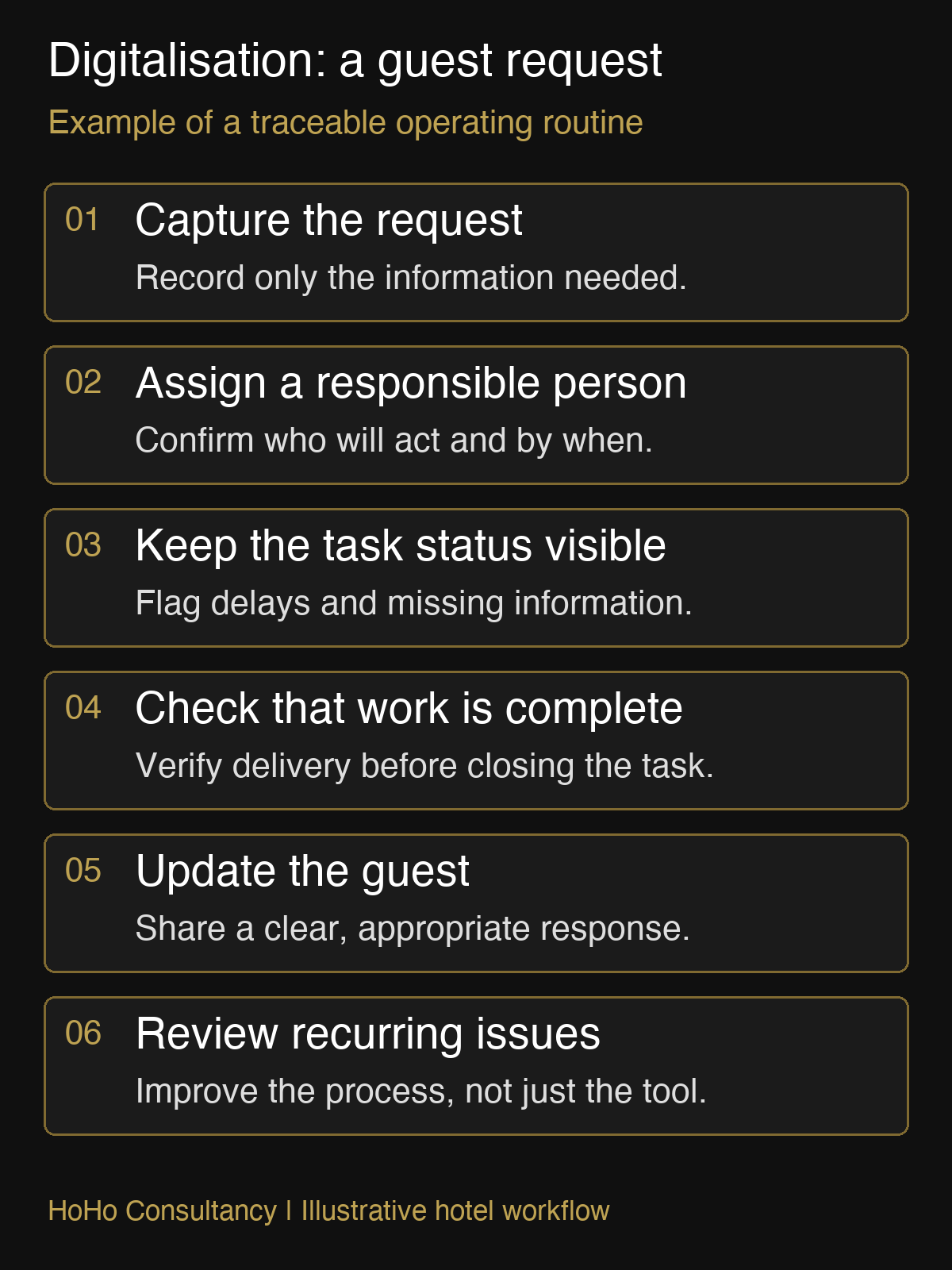
Before automating this routine, agree who can see the information, who may close the task and how staff will act if the system is unavailable. Digitalisation should make responsibilities clearer; it does not remove the need to check whether the guest’s request has actually been resolved.
Consolidate agreed hotel KPIs and draft summaries for managers to check against source records.
Prepare cash-flow, payroll and capital spending scenarios using documented assumptions and management review.
Capture invoice details, flag mismatches and route approvals, with checks before posting or payment.
Flag possible differences in rates or contract data for commercial and specialist review.
Coordinate schedules, task handovers and routine approvals with clear owners and access controls.
Track agreed document deadlines and review dates; responsible staff remain accountable for compliance.
We scope hotel digitalisation around specific tasks, a baseline and measurable acceptance criteria.
We assess PMS, CRM and reporting connections before committing to an integration or rollout.
We support staff training, workflow ownership and ongoing review so teams can use the agreed processes.
The scope can include a workflow and data audit, reporting definitions, automation design, implementation coordination, staff training and handover. We assess your existing systems before proposing integrations or AI use. Each hotel digitalisation engagement specifies deliverables, responsibilities, dependencies and acceptance criteria. Software licences, specialist advice and ongoing support should be identified separately where relevant, so you can assess the complete commitment.
Hotel digitalisation is relevant to owners, operators, general managers and project developers who need more consistent processes and usable reporting. A small boutique hotel may start with one recurring handover or report; a multi-property group may need shared definitions and governance. We assess your staffing, seasonality, current systems and management capacity before recommending a scope. A clearly defined operational problem is a better starting point than a wish to introduce AI everywhere.
We assess the tools and supplier arrangements you already have before recommending replacements. Some improvements require only a clearer process, configuration change or controlled export. Where an integration or new product is justified, we compare its capabilities, costs, dependencies and support requirements with the alternative. Hotel digitalisation should include testing and a transition plan; a replacement is not assumed to be necessary or automatically better.
We agree the outcomes and starting measurements before implementation. Depending on the workflow, these may include reporting time, unresolved handovers, duplicate entries or the proportion of tasks completed on time. Hotel digitalisation can support better coordination, but savings and revenue effects depend on your data, systems, staffing and adoption. We compare results with the baseline and record exceptions; we do not guarantee a particular financial return or an error-free process.
We adapt the scope to your hotel concept, operating model, team capacity and reporting needs. Common definitions and responsibilities can coexist with different service styles. Your staff help test the proposed workflow using realistic situations, including busy shifts and exceptions. We document where a process is standard and where local judgement is appropriate. This makes hotel digitalisation easier to maintain as staff, suppliers or business requirements change.
Potential starting points include front-office handovers, housekeeping room status, maintenance requests, F&B purchasing information and finance reporting. There is no universal order of benefit. We prioritise hotel digitalisation by examining how often a task occurs, how much work it creates, what can go wrong and whether the available data is reliable. Your first pilot should be small enough to test properly and important enough for the team to use consistently.
AI tools can make mistakes and require controls suited to the task and the data involved. We agree permitted uses, access boundaries, review responsibilities and approval steps before rollout. Staff check generated summaries against source records, and management approves consequential actions. Testing, training and ongoing review are part of the workflow; no tool or implementation is risk-free.
For background on staff competence, see the European Commission’s AI literacy questions and answers. Your appointed legal and data-protection advisers should assess obligations for your specific implementation.
Start with a discussion of your property, existing systems and the process you most want to improve. Bring a short description of the problem, the people involved and any relevant reporting examples with unnecessary personal information removed. We can then assess fit and define a paid engagement where appropriate. Scope, deliverables, fees and support are agreed before work begins. Contact HoHo Consultancy about hotel digitalisation in Cyprus.
Choose one routine that the team can test without changing every department at once. Name the process owner, define access to the information and agree an exception route. Decide which outputs need human review, how staff will practise and what evidence would justify continuing. These are planning questions, not a claim that a particular tool will deliver a guaranteed saving.
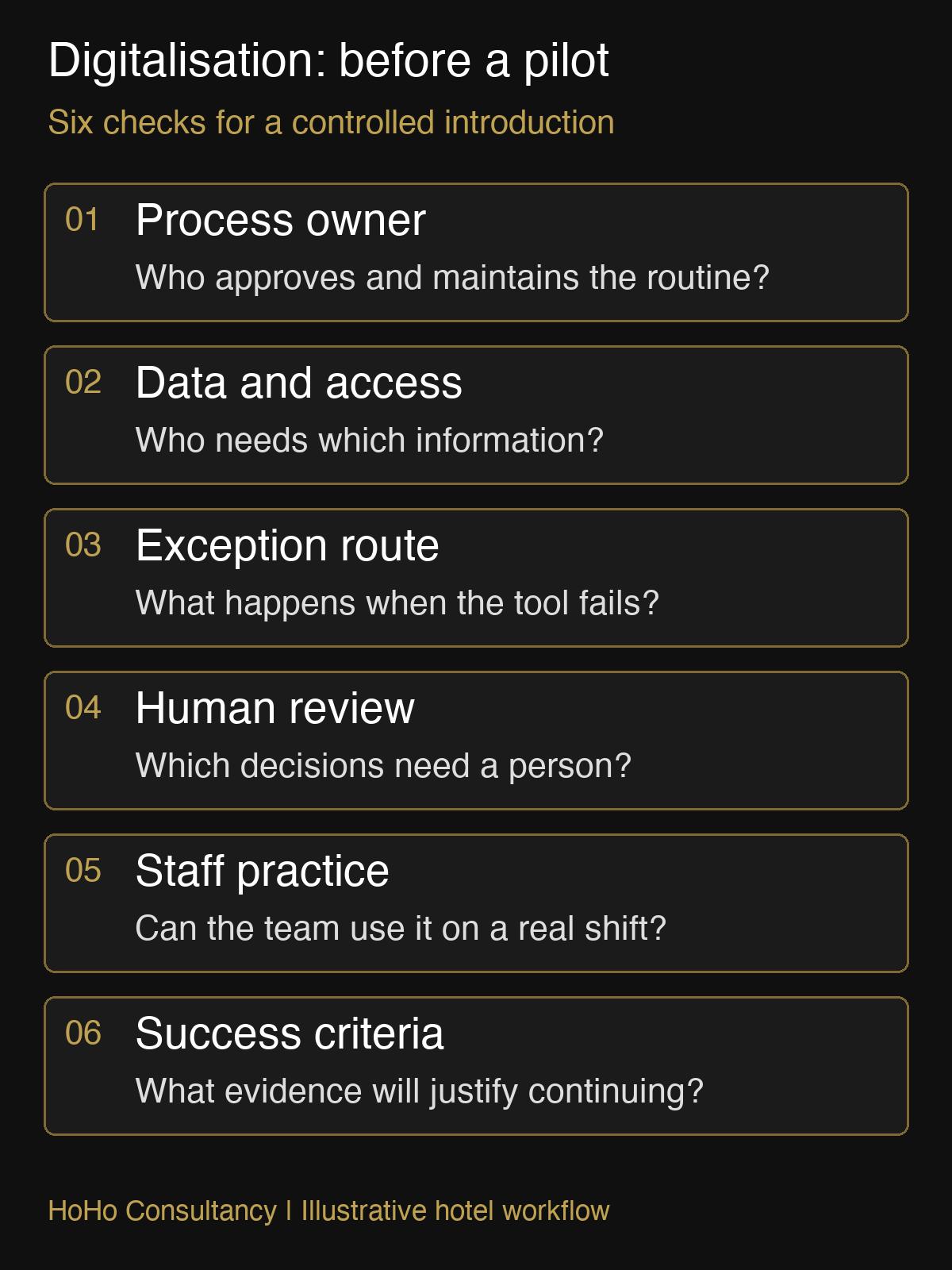
For example, a pilot could test whether the next shift can identify outstanding maintenance requests without searching several message threads. Record the starting process and review missed handovers, unresolved tasks and staff feedback before deciding whether to expand the workflow.
| Cookie | Duration | Description |
|---|---|---|
| cookielawinfo-checbox-analytics | 11 months | This cookie is set by GDPR Cookie Consent plugin. The cookie is used to store the user consent for the cookies in the category "Analytics". |
| cookielawinfo-checbox-functional | 11 months | The cookie is set by GDPR cookie consent to record the user consent for the cookies in the category "Functional". |
| cookielawinfo-checbox-others | 11 months | This cookie is set by GDPR Cookie Consent plugin. The cookie is used to store the user consent for the cookies in the category "Other. |
| cookielawinfo-checkbox-necessary | 11 months | This cookie is set by GDPR Cookie Consent plugin. The cookies is used to store the user consent for the cookies in the category "Necessary". |
| cookielawinfo-checkbox-performance | 11 months | This cookie is set by GDPR Cookie Consent plugin. The cookie is used to store the user consent for the cookies in the category "Performance". |
| viewed_cookie_policy | 11 months | The cookie is set by the GDPR Cookie Consent plugin and is used to store whether or not user has consented to the use of cookies. It does not store any personal data. |
Fields marked with * are required.