
When performance deteriorates, owners need a clear account of what is happening and who will act. HoHo Consultancy supports hotels in Cyprus with performance diagnostics, recovery planning and interim management within an agreed mandate.
Planning your next step? Read our guide: What should a 13-week cash-flow forecast for a hotel contain?.

Hotel turnaround support is intended for owners and operators who need to understand persistent pressure on trading or service delivery. Warning signs may include unclear cost movements, inconsistent operating standards, unresolved guest complaints or a management team without enough capacity to follow through on decisions.
The first task is to establish what is happening. Low profitability can have several causes, and a headline figure does not reveal which actions are appropriate. We review available information with management, record gaps and separate immediate operating issues from decisions requiring further analysis or specialist advice.
Our approach connects commercial, operational and organisational questions. Pricing and channel issues may require a focused hotel revenue management review. Inconsistent delivery may require clearer operating procedures and staff training. A temporary leadership gap may call for an interim management mandate with explicit authority and reporting lines.
Before work begins, we agree the scope, responsibilities, information required and review process. The plan should be realistic for the property’s resources and adapted as evidence improves. We do not promise a fixed recovery timetable or assume that every performance issue can be solved by reducing costs. The aim is a documented route from diagnosis to action, with the owner able to see progress and outstanding decisions.

We start by assembling the information needed to understand the hotel’s position. Available trading reports, operating observations and management concerns are reviewed together. The hotel turnaround diagnostic separates verified facts from assumptions and identifies questions that need further evidence.
The initial scope covers the decisions the owner actually needs to make. We identify immediate service or operating issues, establish who can authorise action and agree how progress will be reported. A short priority list is more useful than an unmanageable catalogue of improvements.
The output is an agreed starting position and an action register with named responsibilities. Where information is unreliable, we record the limitation and specify how it can be checked. This gives the assignment a practical basis without promising that all causes of underperformance will be clear at the first meeting.
Hotel turnaround decisions require a realistic view of expected receipts, commitments and available resources. We work with the owner, management and finance advisers to identify the information needed for short-term planning and the assumptions behind any forecast.
The operating review can examine purchasing approvals, inventory routines, staffing decisions and the way department spending is monitored. Proposed changes are assessed for their effect on delivery as well as cost. The hotel must understand which commitments are contractual and which decisions require professional advice or additional authority.
A practical outcome is a clearer review routine, documented questions and assigned follow-up. Any negotiation or financial decision remains within the agreed mandate. The timing of improvement depends on the circumstances; the assignment does not guarantee liquidity within a fixed number of days or replace accounting, legal or insolvency advice.
We review how work moves between reception, housekeeping, maintenance and other departments. Hotel turnaround problems often require specific investigation: an unresolved room defect, an unclear handover or a purchasing exception should have an owner and a route to resolution.
The operating plan defines practical checks, escalation responsibilities and review dates. Standards should reflect the offer guests have booked and the resources available to deliver it. A procedure that the team cannot use reliably needs revision rather than simply more documentation.
Where appropriate, the assignment connects with SOP development and staff training. Managers test the revised routine, record exceptions and discuss what remains difficult. Progress is assessed through relevant observations and measures, with no assumption that introducing a checklist will automatically improve reviews or financial performance.
The commercial part of a hotel turnaround examines whether the offer, pricing and distribution approach fit the property’s situation. We review available demand information alongside operating capacity and the guest experience the hotel can realistically provide.
Potential actions may involve room descriptions, packages, rate plans, channel costs or the handling of enquiries. These decisions need a clear rationale and an appropriate period for evaluation. Occupancy alone does not establish whether a change improves the business, particularly when acquisition costs or service requirements differ.
A focused revenue management review may be appropriate where pricing and forecasting are the main issues. If the property requires a broader change in concept, we clarify that development work separately. Commercial improvements are assessed against evidence rather than expressed as a guaranteed uplift.
Interim management provides temporary leadership capacity under an agreed mandate. Before work begins, we define the role, reporting relationship, decision limits and how the assignment will interact with the hotel’s existing managers. The scope should match the actual leadership gap.
Hotel turnaround work can place additional pressure on a team already handling daily operations. We therefore agree a manageable review rhythm and clear responsibilities for priority actions. Staff need to know which instructions apply, who can resolve conflicts and how to escalate an issue that exceeds their authority.
Training and coaching focus on the routines the team will continue after the assignment. Any proposed organisational change requires appropriate consultation and specialist advice where relevant. The objective is coordinated execution and a clear transfer of responsibility, not an assumption that temporary leadership can resolve every staffing or performance issue.
The hotel turnaround plan brings agreed actions into one reviewable record. It identifies priorities, responsible people, dependencies and the information needed to assess progress. Targets are kept distinct from forecasts and actual results so stakeholders can interpret the report correctly.
We agree which measures are useful for the assignment and avoid collecting figures without a decision purpose. A progress discussion should cover completed actions, emerging issues and decisions needed from the owner. Where results differ from expectations, the review investigates the cause rather than automatically crediting or blaming the plan.
The handover records routines to continue, access and reporting responsibilities, and unfinished work. Management should understand the limitations of the available evidence and the next review dates. Further head office support can be scoped separately if the hotel needs ongoing coordination after the interim mandate ends.
A hotel turnaround plan connects immediate operating priorities with the information and responsibilities needed to act. Interim management can provide additional leadership capacity where the mandate, authority and reporting arrangements have been agreed.
Identify urgent operating issues, clarify responsibilities and establish a reliable view of available information.
Assess pricing, distribution costs and booking demand alongside the hotel’s ability to deliver its offer.
Clarify decision limits, department priorities and practical routines for following up agreed actions.
Use specific guest feedback to investigate service problems and assign practical corrective actions.
Review handovers, purchasing and service routines to address avoidable errors and inconsistent delivery.
Maintain an action plan with evidence, responsible people, review dates and unresolved decisions.
Connect operating priorities with cash visibility and the hotel’s commercial position.
Define interim leadership responsibilities and support practical coordination across departments.
Maintain clear progress reports, documented assumptions and an organised management handover.
Hotel turnaround management is a structured assignment to investigate underperformance, prioritise action and coordinate implementation. It can address operating routines, commercial decisions, management capacity and the visibility of relevant financial information. The starting point is the property’s actual circumstances and the evidence available.
A recovery plan should identify responsibilities, assumptions and review dates. It should also distinguish matters management can address directly from those needing specialist advice. The purpose is to create a practical route from diagnosis to action; it does not guarantee a return to profitability or remove the uncertainty facing the business.
Interim management is temporary leadership under a defined mandate. The assignment may address a vacant role, additional management capacity or specific responsibilities during a hotel turnaround. Before starting, we agree the scope, reporting lines, authority and expected involvement at the property.
The interim manager works with the existing team and records decisions and outstanding actions. Responsibilities requiring specialist qualifications or separate professional advice are clarified rather than assumed. A handover plan identifies who will take over the role and which routines must continue. The arrangement is time-limited and distinct from appointing a long-term white label hotel operator.
Consider support when persistent operating or commercial problems exceed the time or expertise available within the management team. Relevant signs might include unexplained cost movements, unresolved service issues, weak reporting or a leadership vacancy. A single poor trading period does not establish the cause of a problem.
An initial discussion should clarify the property’s situation, the decisions required and the information available. The scope may be a focused review rather than a full hotel turnaround assignment. Urgent financial, legal or safety concerns need appropriate qualified support and should not wait for a general operational review.
For official information on operating a tourist establishment, consult the Cyprus government’s hotel and tourist establishment guidance. A consulting assignment does not replace the applicable licensing process.
Start dates and the first review milestones depend on availability, the agreed mandate and access to information. We discuss these before confirming an assignment. Some organisational steps can be implemented earlier than changes in trading performance can be assessed.
There is no reliable universal promise that a hotel turnaround will produce results within seven or fourteen days. Seasonality, existing commitments, team capacity and the causes of underperformance all affect the timetable. We therefore agree practical milestones, report what has actually been completed and separate those activities from any business outcome that still requires observation.
The measures depend on the assignment. Relevant information may include cash forecasts, departmental costs, room trading, channel costs, guest feedback and progress against agreed actions. Each measure needs a definition, a responsible person and a consistent reporting period.
We avoid treating a single indicator as a complete picture of the hotel. Higher occupancy does not automatically establish higher profit, and a target is not an achieved result. A hotel turnaround review should explain material changes and identify questions requiring investigation. Where financial interpretation or assurance is needed, management should involve its qualified finance advisers.
Yes. The scope can support an existing management team or cover a specific temporary gap. We agree how responsibilities will be shared, who approves decisions and how department heads will receive instructions. The aim is to provide useful capacity without creating conflicting lines of authority.
Hotel turnaround work should recognise the team’s existing knowledge and daily operating workload. Training focuses on the routines and decisions staff will continue to handle. Where written standards are missing, SOP development and staff training can form part of an agreed implementation plan.
The agreed deliverables may include a diagnostic summary, an action plan, reporting definitions, documented operating routines and a handover record. The exact package depends on the scope confirmed at the start. Completed actions should be distinguished from outstanding work and decisions that remain with the owner.
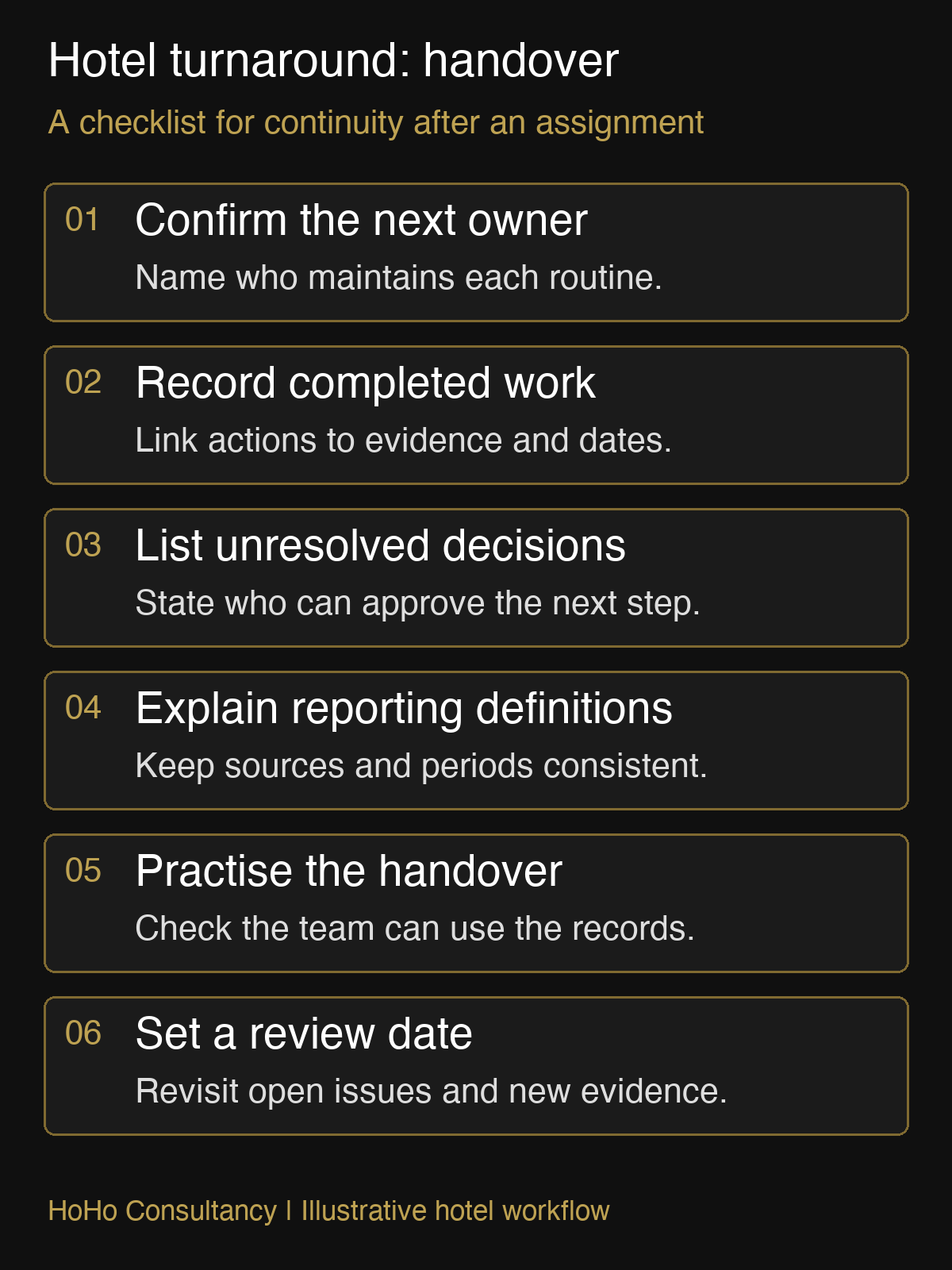
A hotel turnaround handover also identifies who will maintain each routine and when progress should next be reviewed. It should record limitations in the available evidence and any unresolved risks. The assignment leaves a practical management foundation; it cannot guarantee that future trading or operating performance will remain stable.
A hotel turnaround assignment should finish with a working handover, not simply a folder of recommendations. Use this checklist to confirm continuity with the owner and incoming manager:
The hotel turnaround action log should remain accessible to the people responsible for follow-through. Separate completed work from expected benefits that have not yet been measured.
| Cookie | Duration | Description |
|---|---|---|
| cookielawinfo-checbox-analytics | 11 months | This cookie is set by GDPR Cookie Consent plugin. The cookie is used to store the user consent for the cookies in the category "Analytics". |
| cookielawinfo-checbox-functional | 11 months | The cookie is set by GDPR cookie consent to record the user consent for the cookies in the category "Functional". |
| cookielawinfo-checbox-others | 11 months | This cookie is set by GDPR Cookie Consent plugin. The cookie is used to store the user consent for the cookies in the category "Other. |
| cookielawinfo-checkbox-necessary | 11 months | This cookie is set by GDPR Cookie Consent plugin. The cookies is used to store the user consent for the cookies in the category "Necessary". |
| cookielawinfo-checkbox-performance | 11 months | This cookie is set by GDPR Cookie Consent plugin. The cookie is used to store the user consent for the cookies in the category "Performance". |
| viewed_cookie_policy | 11 months | The cookie is set by the GDPR Cookie Consent plugin and is used to store whether or not user has consented to the use of cookies. It does not store any personal data. |
Fields marked with * are required.