
A growth strategy for hotel portfolios in Cyprus must account for leadership capacity, reporting and operating standards.

Our hospitality growth strategy service supports owners, operators and developers considering additional rooms, outlets or properties in Cyprus. It can also help an existing hotel group review whether its management structure and systems are suitable for the next stage of expansion.
The starting point is the proposed operating model, not an assumption that a larger portfolio will automatically perform better. We review the information available about the opportunity, the capacity of the existing team and the requirements that need specialist investigation.
A useful growth strategy identifies priorities, decision responsibilities and dependencies. It considers which routines can be shared across hotels and which must reflect the location, guest offer and facilities of each property. Financial scenarios are treated as assumptions for review, not guaranteed returns.
Where the project involves a new opening or substantial repositioning, our hotel development consultancy can support operating readiness. Ongoing coordination may connect with head office support, while an owner seeking a partner to run the property can explore our hotel operations approach. The scope is agreed around the decisions you need to make, with appropriate legal, technical and financial due diligence handled by qualified advisers.

We start the growth strategy review with the business you already operate and the opportunity you are considering. Available reports, management responsibilities and existing procedures help identify whether the organisation has capacity for the proposed expansion.
The assessment records what is known about the target property or development and what still requires investigation. Operating assumptions should be distinguished from verified information. We consider dependencies such as leadership availability, systems, service requirements and the time needed to prepare the team.
The output is a readiness summary and a list of priorities for further work. This can inform the next decision without replacing legal, technical or financial due diligence. If the project involves opening or repositioning a hotel, the work can connect with our hotel development consultancy to assess operating readiness in more detail.
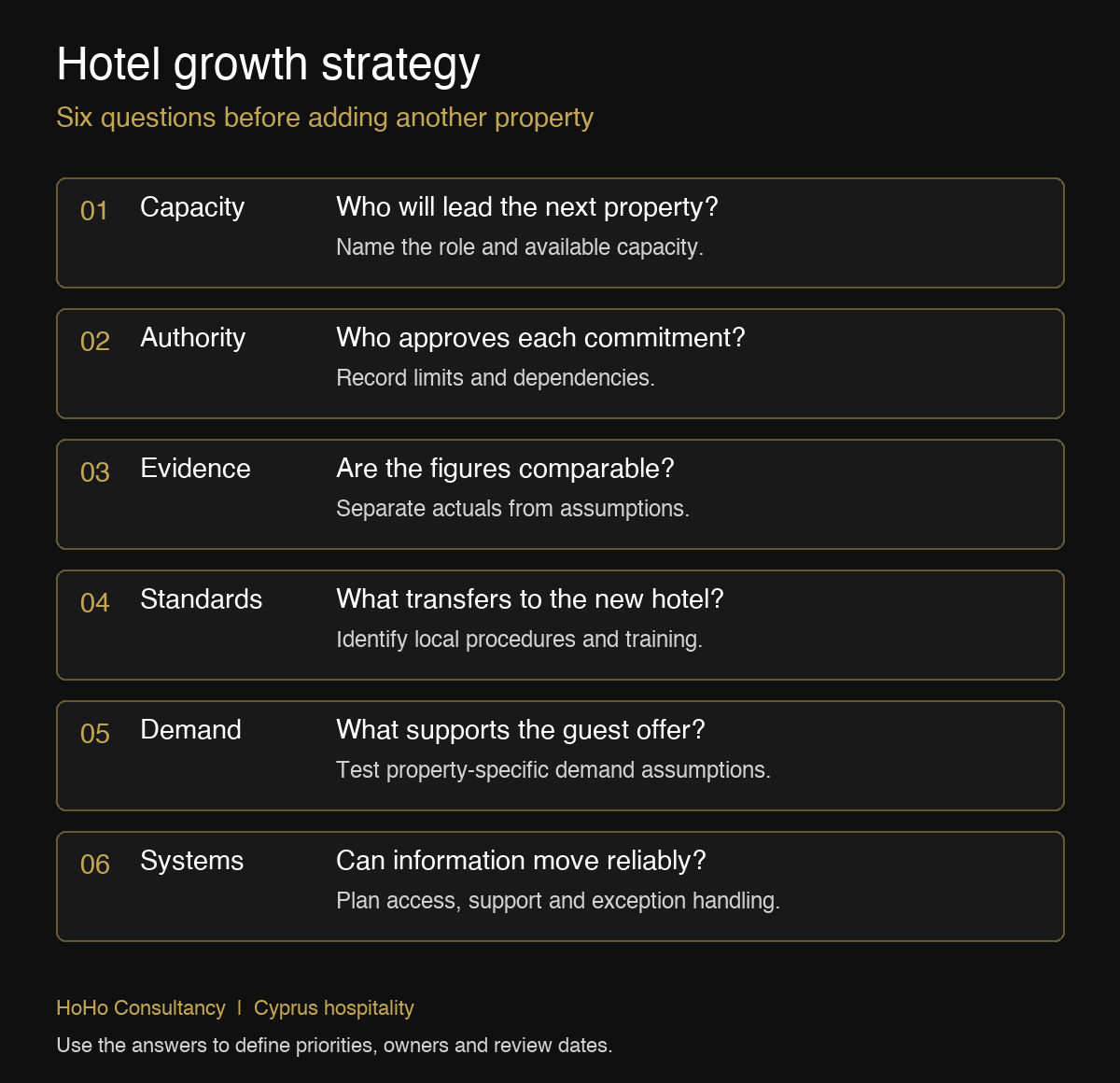
A growth strategy needs clear authority at both portfolio and property level. We identify which decisions belong to the owner, which can be made centrally and which require local management input. The arrangement should fit the actual operating model.
Responsibilities may cover budgets, commercial changes, purchasing, staffing coordination and standards maintenance. The plan records approval limits and a route for resolving issues that cross departments or properties. Reviews should focus on the decisions needed and the evidence supporting them.
The implementation schedule identifies dependencies and unresolved questions. Dates based on assumptions are labelled accordingly and reviewed as the project develops. This provides a practical coordination structure, while recognising that external approvals and specialist work may affect timing. The aim is accountable decision-making, not a claim that a governance framework makes an expansion risk-free.
Portfolio reporting within a growth strategy should use agreed definitions and explain differences between hotels. We review the sources and periods behind selected commercial and operating measures before deciding what can reasonably be compared.
A property with a shorter season, different facilities or a different cost allocation may not be directly comparable with another hotel. Reports should make that context visible. Forecasts, budgets and illustrative scenarios are separated from achieved results, and important assumptions are documented.
The review identifies questions requiring investigation and assigns follow-up to the relevant people. A dashboard is a way to organise information, not proof of asset value or future returns. Where the decision requires financial modelling or assurance, the appropriate qualified advisers should review the assumptions and conclusions. The resulting structure supports discussion without overstating what the data can establish.
Assume an additional 24 rooms are available for 30 days at an average daily rate of €120. At 40%, 60% and 80% occupancy, the room revenue calculation is respectively €34,560, €51,840 and €69,120: available rooms × days × occupancy × average daily rate.
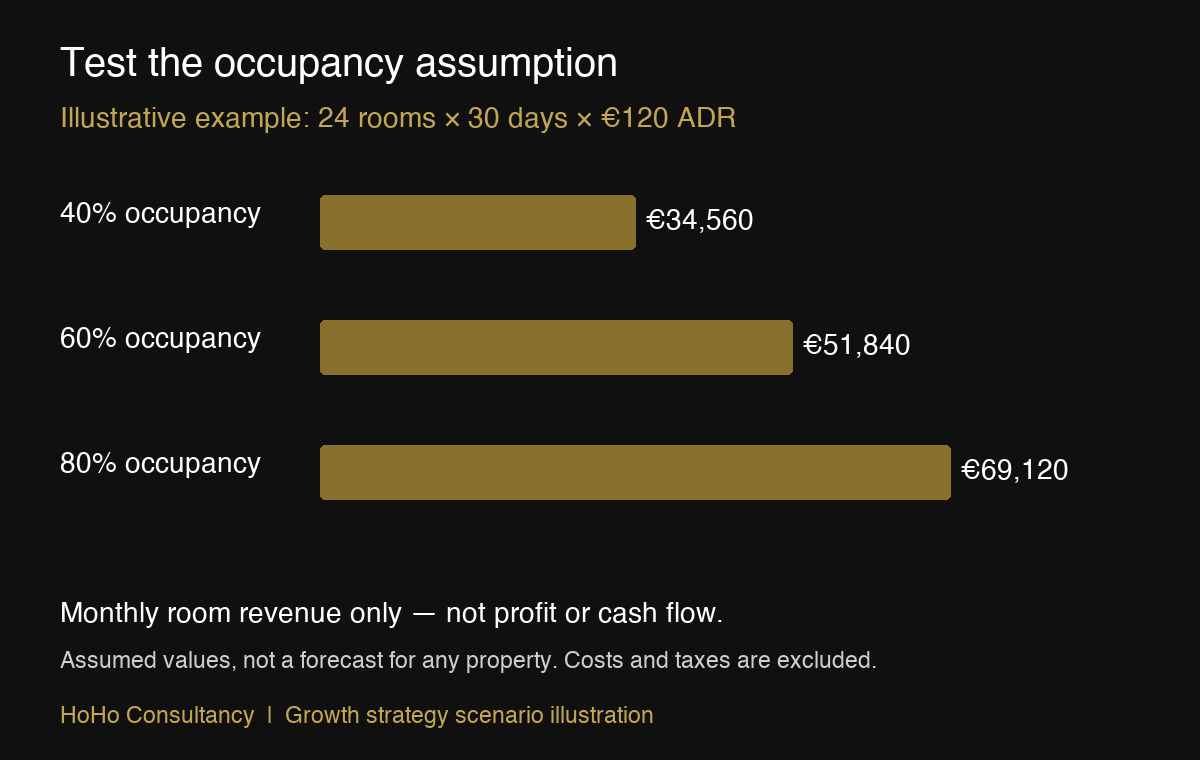
These are illustrative assumptions, not a forecast or a benchmark for Cyprus. The example excludes costs and taxes and does not calculate profit, funding needs or cash flow. Its purpose is to show why a growth strategy should test its demand assumptions before an owner commits to expansion. A property-specific assessment must also consider the costs, timing and evidence supporting each scenario.
We identify which standards can be shared across the portfolio and which depend on the local hotel. A growth strategy should preserve useful consistency without assuming that different layouts, equipment or guest offers can use identical instructions.
The operating plan assigns document ownership and a process for approving local variations. Training requirements are considered alongside staffing and implementation capacity. Before a procedure is applied more widely, the team should test it in the relevant operating conditions and record adjustments.
Detailed procedure work can be scoped through SOP development and staff training. The deliverable is a clear structure for transferring knowledge and maintaining standards, with responsibilities for review. It does not replace property-specific checks or specialist requirements. The growth plan should allow time for these activities instead of treating documentation as complete implementation.
A hospitality growth strategy considers how the new property will reach guests and how its offer relates to the existing portfolio. We review the commercial decision process, available demand information and the operating requirements behind proposed packages or positioning.
Shared reporting can help owners understand pricing and channel decisions, but each hotel needs an approach appropriate to its market and offer. We distinguish common review principles from property-level choices. Acquisition costs, booking conditions and operational capacity should be considered alongside room revenue.
A more detailed revenue management and distribution review can be included where agreed. The plan identifies who makes decisions and how they will be assessed. It should not assume that a channel mix or pricing approach that works at one property will produce the same outcome at another.
The final part of the growth strategy connects the proposed operating model with the systems and support needed to run it. We map information flows, reporting responsibilities and the additional work that expansion will create for central and on-site teams.
Existing tools are reviewed before new technology is proposed. Any integration or automation needs clear inputs, access arrangements, exception handling and testing. Training and maintenance responsibilities belong in the implementation plan, together with realistic assumptions about available time.
Our digital workflows service can assess technical requirements, while head office support can address defined recurring coordination. The scope and costs of those services are agreed separately. The result is a more complete view of what the expanded business will require, rather than a promise that adding technology alone will make growth profitable or easy to manage.
The final step turns the strategy into a scalable operating machine. Our Growth Strategy for Hospitality framework installs systems and workflows that support portfolio management without admin chaos. We standardise templates, reporting formats, and management routines so information is comparable and decision-ready.
A practical growth strategy connects the proposed opportunity with the people, systems and operating model needed to deliver it. We organise the available evidence, identify assumptions and clarify the questions that need further investigation.
Define the property characteristics and operating requirements relevant to your expansion plan.
Review available information and identify questions requiring further due diligence.
Assess the demand assumptions, access and local context relevant to the proposed hotel.
Compare the proposed guest offer with the property’s facilities and operating requirements.
Examine revenue and cost assumptions with transparent scenarios and identified limitations.
Organise findings, open questions and specialist input needed before an acquisition or development decision.
Assess the operating context of hotel expansion opportunities in Cyprus.
Separate verified information, scenario assumptions and questions requiring specialist due diligence.
Plan responsibilities, systems and implementation before adding another property.
Practical questions about hospitality growth strategy and portfolio readiness. For official information relevant to a hotel project in Cyprus, consult the government’s hotel and tourist establishment guidance alongside your property-specific professional advice.
A hospitality growth strategy reviews what the business needs to add rooms, outlets or properties. The scope can include operating readiness, management responsibilities, reporting, shared standards and the systems required for the proposed expansion.
We agree the work around the decisions you need to make. The output may include a readiness assessment, implementation priorities and a list of questions requiring further investigation. It does not replace legal, technical or financial due diligence, and it is not a guarantee of returns. A useful plan makes assumptions and dependencies visible before commitments are made.
The service can support owners, operators and developers considering expansion in Cyprus, as well as existing groups reviewing their portfolio structure. It may be relevant before an acquisition, a new opening or a substantial increase in operating capacity.
The appropriate scope depends on the opportunity and the business’s current capabilities. A single-property owner may need an initial readiness review, while a group may need more detailed coordination across locations. Growth strategy work should remain proportionate to the decision, with specialist advice involved where the project requires it.
The timetable depends on the available information, the number of properties and the decisions being assessed. We agree review milestones and distinguish completed planning work from business results that can only be evaluated after implementation.
A clearer responsibility matrix or a consistent report format may be an early deliverable. Neither proves that an expansion will succeed financially. The growth strategy should identify dependencies, uncertainties and the next decision dates. We do not promise a fixed time to improved profitability or assume that all projects can follow the same rollout schedule.
No. We distinguish shared management principles from procedures that depend on the local property. Common definitions and reporting formats can support a portfolio review, while service delivery may need to reflect different layouts, facilities and guest expectations.
A growth strategy should identify which local variations are appropriate and who approves them. Detailed procedures can be developed through SOP development and staff training. The objective is a clear operating structure that fits each hotel, rather than identical instructions imposed without practical testing.
Commercial planning can be included in the agreed scope. We review how pricing, distribution and the guest offer are managed, and how decisions are reported at property and portfolio level. Shared principles do not require identical pricing or channels across different hotels.
Where detailed analysis is needed, our revenue management service can examine the available data and decision process. The growth strategy should recognise local demand, acquisition costs and operating capacity. Commercial assumptions remain subject to review and should not be presented as guaranteed revenue or profit.
We organise agreed actions with named responsibilities, dependencies and review dates. Progress reviews identify what has been completed, what is blocked and which decision is needed next. Completion should be supported by an agreed form of evidence where appropriate.
Implementation still depends on the authority, resources and cooperation available within the business. Growth strategy support cannot guarantee that every action will happen on time. The value of the process is that outstanding work and decisions remain visible, with a clear route for escalation and adjustment.
Yes, where this forms part of the agreed scope. We map reporting and information requirements, review existing tools and identify where additional workflows or integrations may be useful. New technology should have a defined purpose and a maintenance owner.
Detailed implementation can connect with our hotel digitalisation service, while recurring coordination may fit head office support. The growth strategy records access, testing and training requirements. Any expected efficiency gain remains an estimate until the workflow has been tested in actual use.
Projects outside Cyprus can be discussed according to the location, scope and delivery requirements. We would first clarify which work can be supported remotely, what requires on-site involvement and which local professional advisers are needed.
A growth strategy for another jurisdiction must account for its operating and regulatory context. We do not assume that a Cyprus process or requirement applies unchanged elsewhere. Contact HoHo Consultancy with the proposed location and project outline so availability and a suitable scope can be assessed before any commitment.
| Cookie | Duration | Description |
|---|---|---|
| cookielawinfo-checbox-analytics | 11 months | This cookie is set by GDPR Cookie Consent plugin. The cookie is used to store the user consent for the cookies in the category "Analytics". |
| cookielawinfo-checbox-functional | 11 months | The cookie is set by GDPR cookie consent to record the user consent for the cookies in the category "Functional". |
| cookielawinfo-checbox-others | 11 months | This cookie is set by GDPR Cookie Consent plugin. The cookie is used to store the user consent for the cookies in the category "Other. |
| cookielawinfo-checkbox-necessary | 11 months | This cookie is set by GDPR Cookie Consent plugin. The cookies is used to store the user consent for the cookies in the category "Necessary". |
| cookielawinfo-checkbox-performance | 11 months | This cookie is set by GDPR Cookie Consent plugin. The cookie is used to store the user consent for the cookies in the category "Performance". |
| viewed_cookie_policy | 11 months | The cookie is set by the GDPR Cookie Consent plugin and is used to store whether or not user has consented to the use of cookies. It does not store any personal data. |
Fields marked with * are required.