
Explore hotel consulting services in Cyprus for owners, operators and developers. Our main areas are digital workflows, hotel development and pre-opening, and white-label hotel operations.
Choose support around the decision you need to make: improve an existing process, prepare a property for its next stage or explore an operating arrangement. The service pages below explain the work in more detail. We agree scope, responsibilities and deliverables before starting, based on your property, available information and team.
The right starting point is a decision, not a list of products. An owner preparing a new opening needs different support from a general manager dealing with incomplete reports or repeated service failures. Use this guide to compare the nine service areas and identify the first conversation worth having. You do not need to know the final scope before contacting us.
Our hotel consulting services are organised around operating responsibilities. We ask what needs to change, who can approve it and which people will maintain the new routine. The aim is to make the assignment understandable before work starts. A proposed project should identify deliverables and dependencies rather than leave the team to interpret a broad promise of improvement.
Start with digitalisation and AI workflows when the same information is repeatedly copied between systems, requests lose their owner or managers cannot see whether a task is complete. Describe one actual workflow, such as a guest request passing from reception to housekeeping. Identify the information needed, the people involved and what happens when the usual process fails.
Hotel consulting services in this area can connect process design with system requirements. Buying another application is not automatically the first step. These hotel consulting services distinguish a missing function from inconsistent use of an existing tool. It also considers access, human review, staff practice and the arrangements needed when a system is unavailable.
Prepare a simple list of the systems in use and one example of the difficulty. The initial discussion does not require passwords or guest records. A possible deliverable is a defined pilot with a process owner, exception route and acceptance criteria. Review the pilot before extending it across departments.
Consider hotel development and pre-opening support when preparing a new property, a relaunch or a repositioning. The operational questions include the intended guest, service promise, facilities, departmental responsibilities and the steps needed before the team can deliver. These decisions affect one another and should be discussed together.
Hotel consulting services can help make operational dependencies visible to the project team. For example, a proposed restaurant concept needs to be considered alongside kitchen capacity, staffing and service arrangements. The consultant’s operating brief should sit alongside the work of the appointed designers, engineers and other specialists, with responsibilities clearly separated.
For an initial review, describe the location, property type, development stage and decisions already made. Explain whether the opening date is a firm commitment or a planning assumption. The scope may include an operating concept, readiness checklist or coordination of agreed workstreams. Hotel consulting services do not replace the approvals or professional assessments required for the property.
If you want another party to operate the hotel, begin with the white-label hotel operator page. This involves a property and commercial assessment before any operating proposal. Owners need to distinguish advice, temporary management, an operating agreement and a lease; these are different arrangements with different responsibilities.
A purchase of hotel consulting services does not itself appoint HoHo as the operator. An operating discussion needs to address the asset, investment requirements, existing team, trading position and proposed allocation of responsibilities. Reporting arrangements and approval rights also need to be understood before the parties can assess whether a model is workable.
Prepare an overview of the property and the outcome you are seeking. State what you want to retain responsibility for and what you want the prospective operator to handle. Detailed records and commercial terms can then be addressed through an agreed process. An initial conversation about hotel consulting services is an assessment of fit, not an unconditional commitment to take over the business.
Explore turnaround and interim management when persistent operating problems exceed the team’s available time or when a leadership gap needs a defined temporary response. Explain the symptoms without assuming the cause. Incomplete reporting, repeated guest complaints and unclear departmental accountability may require different interventions.
Hotel consulting services can provide a structured diagnosis and action plan, while an interim assignment requires an explicit mandate. Clarify who gives instructions, who approves expenditure and how the existing management team will be involved. A temporary appointment should also include a handover plan so that responsibilities do not become unclear when the assignment ends.
Useful starting information for hotel consulting services includes the current organisation chart, unresolved operating issues and available management reports. Separate urgent matters requiring qualified specialist attention from the general review. Progress should be reported as completed actions and observed results, rather than assuming that a fixed number of days will restore profitability.
The revenue management and distribution service is relevant when pricing, forecasts and channel decisions lack a consistent review process. A hotel may need to understand how booking patterns, room availability, restrictions and distribution costs interact. Occupancy alone does not answer every commercial question.
Hotel consulting services in this area should clarify the information behind decisions. Explain which reports are available, how often they are reviewed and who is authorised to change rates or restrictions. A useful assignment can establish definitions, decision responsibilities and a review calendar that the commercial team can maintain.
Prepare a summary of the room types, principal channels and current pricing process. Identify whether the concern is future demand, inconsistent controls, channel cost or a lack of management visibility. Forecasts prepared within hotel consulting services remain assumptions to be updated as evidence changes. Review the effects of decisions across the appropriate trading period rather than treating one favourable day as proof of a lasting improvement.
Choose SOP development and staff training when standards depend on individual memory, new team members receive inconsistent instructions or departmental handovers create avoidable confusion. Start with a task the team performs regularly. Describe what good completion looks like and what staff should do when the normal instruction cannot be followed.
Hotel consulting services should connect written procedures with practical use. A document needs an owner, a version and a way to check that people understand it. Training within hotel consulting services can include demonstration, supervised practice and feedback from the people who perform the work. A long manual that nobody can apply is not a useful endpoint.
Bring an existing procedure or a description of the task, along with examples of where it breaks down. Possible outputs include revised instructions, supervisor checks and a training plan. Specialist requirements should remain with appropriately qualified people. The agreed scope should state who approves a procedure and who maintains it after the project.
Start with F&B consulting when a restaurant, bar or breakfast operation needs clearer positioning, more reliable costing or better coordination. Describe the outlet’s role in the hotel and the guests it is intended to serve. An external restaurant audience may require a different offer from a breakfast operation serving residents.
Hotel consulting services can review menu contribution, purchasing, stock movements, preparation and service together. An attractive recipe calculation does not establish the outlet’s full profitability. Labour, waste, availability and the practical demands of delivering the menu still matter. Decisions should reflect both guest expectations and the team’s operating capacity.
A current menu, opening periods and a summary of the problem are useful for the first discussion. Detailed recipe and sales records can follow within the agreed assignment. Potential deliverables include a concept brief, menu review or management routine. Proposed changes should be tested and reviewed before being treated as a permanent solution.
Consider head-office support when reporting, administration or coordination needs a more dependable routine. Identify which recurring tasks lack ownership, which deadlines are missed and where information changes hands. The review should make responsibilities visible across the hotel and any external support team.
Hotel consulting services in this area do not automatically transfer every administrative responsibility. The agreement should distinguish coordination from approval, preparation from professional review and routine reporting from specialist advice. The appointed accountant, legal adviser and system provider retain their agreed roles. Staff need to know where a question should be directed.
Prepare a list of recurring reports, their intended readers and their source records. A useful output may be a responsibility matrix and reporting calendar. Every report should lead to a decision, investigation or confirmation that no action is needed. Avoid building a large dashboard before clarifying who will use it and what they need to decide.
Explore growth and strategy when considering a broader offer, another property or a change in positioning. Define the proposed opportunity and the operating demands it would create. Expansion can require management capacity, consistent reporting and a service model that can be maintained across more than one location.
Hotel consulting services can help organise the questions and dependencies before resources are committed. A strategy should distinguish confirmed information from assumptions about demand, capacity and delivery. Owners need to understand which decisions can be made now and which depend on further evidence or specialist input.
For the first discussion, describe the current business, proposed change and constraints. State what you would need to learn before proceeding. The assignment may produce an options assessment, staged implementation plan or review framework. Growth should remain a decision to evaluate, with clear checkpoints, rather than an outcome assumed simply because a plan has been written.
Some projects involve several services. A hotel reopening may need development coordination, recruitment readiness, operating procedures and commercial planning. Start by identifying the main decision and the work that depends on it. This avoids asking several people to solve the same issue or beginning implementation before the operating concept is sufficiently clear.
When combining hotel consulting services, name one responsible project lead and define the interfaces between workstreams. Record which deliverable each team needs from another, when it is required and who can approve it. A shared action log should distinguish an information request from a decision and a completed task from a result that still needs monitoring.
Do not assume that every available service belongs in one engagement. A focused first phase may be enough to resolve the immediate question. Additional work should be discussed when the evidence supports it, with a revised scope and clear responsibilities. The aim is a coherent assignment that the hotel can participate in and sustain.
You can begin with a short property overview. Include its location, type, approximate scale, trading or development stage and the issue you want to address. Explain who is involved in the decision and whether another adviser or supplier is already working on the matter. This helps us understand the context without requesting an unnecessary volume of records.
For hotel consulting services, useful preparation also means identifying the question you want answered. Examples include whether a reporting routine can be simplified, what is missing from opening readiness or whether an operating proposal warrants further assessment. If you are unsure, describe the practical difficulty and its effect on the team.
Use the first discussion to agree what information is needed next and how it should be handled. Avoid sending passwords, guest-level records or detailed employee information as part of an unsolicited introductory message. The appropriate scope and access arrangements should be established before detailed operational material is shared.
A proposal for hotel consulting services should explain the problem being addressed, the deliverables, the people involved and the assumptions about access to information. It should also identify decisions that remain with the owner or management team. Site attendance, remote work and the expected participation of department heads need to be discussed explicitly.
Agree how changes to the assignment will be handled. New information may reveal a dependency or show that an initial assumption was wrong. Record what has changed, how it affects the work and who approves the next step. A realistic project plan allows issues to be raised without turning every observation into an unplanned additional commitment.
The review schedule should match the work. A procedure can be tested during a shift, while a commercial outcome may require a longer observation period. Separate delivery milestones from business results so that progress remains understandable. The completion of a document is evidence of a deliverable, not proof that every intended benefit has occurred.
Before implementation, record the starting position and define the measures that will be used. Hotel consulting services may involve task completion, reporting accuracy, adoption of a routine or a commercial review. Use consistent periods and definitions. Explain limitations in the available information so comparisons are not presented with more certainty than they deserve.
At each review, ask what changed, what evidence is available and what remains unexplained. Staff feedback can identify a procedure that looks reasonable on paper but is difficult during service. Management should decide whether to retain, revise or stop a change, with responsibility for the follow-up recorded.
The handover should identify the people who maintain the process, the records they need and the next review date. Open decisions should remain visible. Useful hotel consulting services leave the team able to continue agreed routines, while recognising that future trading conditions and operating requirements can change.
Use the service cards to explore the area closest to your immediate decision. Each detailed page explains the relevant process and common questions. If several topics overlap, contact HoHo Consultancy with a short outline so we can discuss the appropriate starting point. We will clarify fit and scope before an assignment is agreed.
For hotel consulting services in Cyprus, an effective introduction states the property, the decision and the constraint. You do not need to prepare a complete business case to begin the conversation. The next step is to establish what needs to be understood, who should participate and what a useful first deliverable would be.
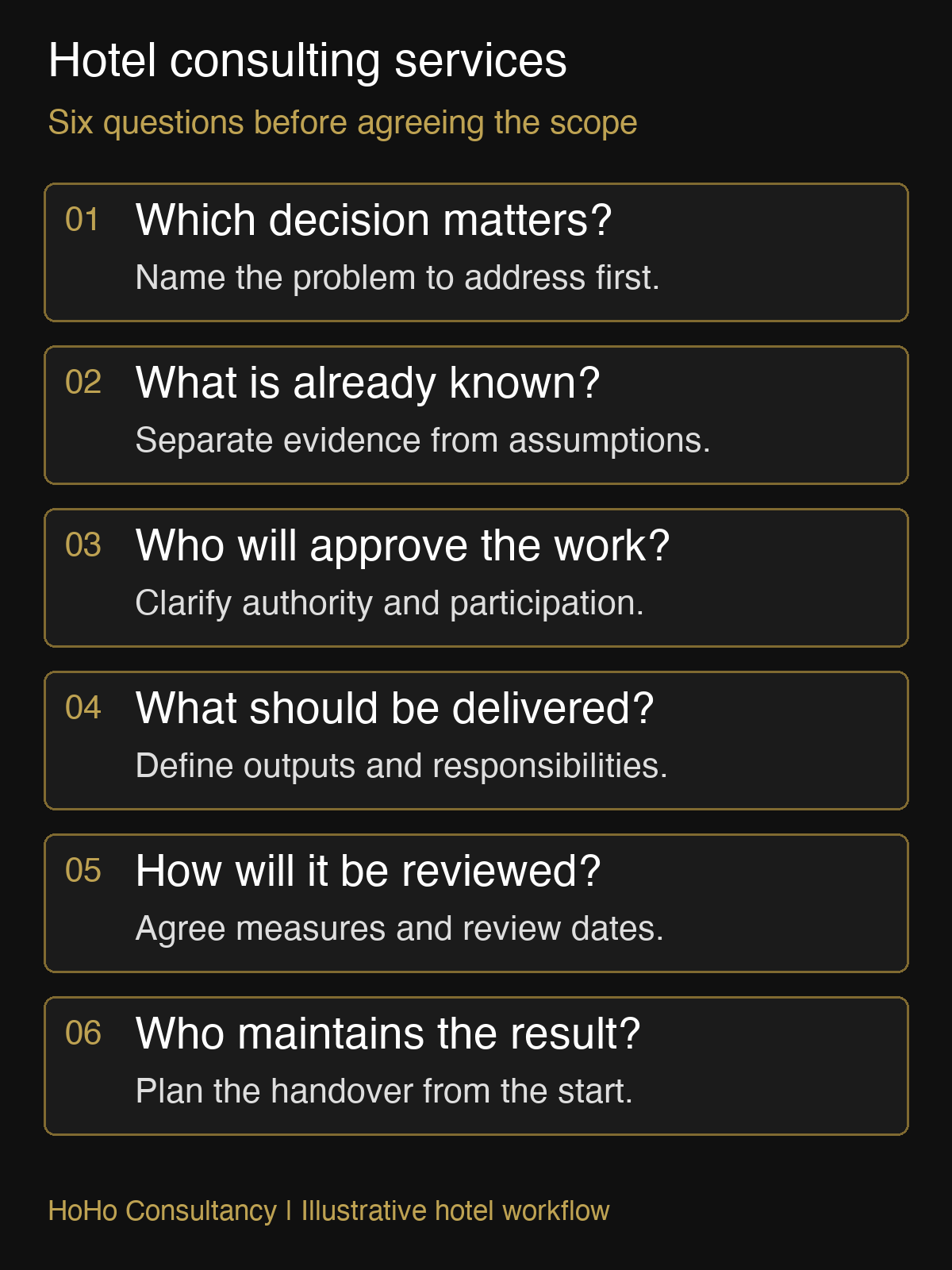
View the scope checklist at full size.


Connect hotel systems, simplify recurring tasks and give teams clear reporting workflows.

Stabilise hotel operations, identify margin leakage and establish accountable day-to-day management.

Plan hospitality growth with property-level priorities, consistent standards and practical performance measures.
Prepare hotel openings, relaunches and repositioning with operating plans, team readiness and commercial foundations.

Build clear hotel procedures and role-specific training for consistent service and smoother handovers.

Align pricing, demand forecasts and distribution channels with your property’s commercial objectives.
Support hotel administration with coordinated reporting, defined responsibilities and practical back-office workflows.

Review restaurant concepts, menu contribution, purchasing and service processes to identify improvements.

Explore hotel operating and lease arrangements in Cyprus, subject to property assessment and agreed terms.
More than 20 years of hospitality experience across operational and leadership roles.
Practical support connecting hotel operations, digital workflows and project delivery.
A defined scope, clear responsibilities and direct discussion of your property’s priorities.
| Cookie | Duration | Description |
|---|---|---|
| cookielawinfo-checbox-analytics | 11 months | This cookie is set by GDPR Cookie Consent plugin. The cookie is used to store the user consent for the cookies in the category "Analytics". |
| cookielawinfo-checbox-functional | 11 months | The cookie is set by GDPR cookie consent to record the user consent for the cookies in the category "Functional". |
| cookielawinfo-checbox-others | 11 months | This cookie is set by GDPR Cookie Consent plugin. The cookie is used to store the user consent for the cookies in the category "Other. |
| cookielawinfo-checkbox-necessary | 11 months | This cookie is set by GDPR Cookie Consent plugin. The cookies is used to store the user consent for the cookies in the category "Necessary". |
| cookielawinfo-checkbox-performance | 11 months | This cookie is set by GDPR Cookie Consent plugin. The cookie is used to store the user consent for the cookies in the category "Performance". |
| viewed_cookie_policy | 11 months | The cookie is set by the GDPR Cookie Consent plugin and is used to store whether or not user has consented to the use of cookies. It does not store any personal data. |
Fields marked with * are required.
Fields marked with * are required.
Fields marked with * are required.
Fields marked with * are required.
Fields marked with * are required.
Fields marked with * are required.