
Hotel revenue management in Cyprus starts with the revenue your property retains. HoHo Consultancy helps owners review pricing, demand forecasts, OTA costs and direct booking priorities.

Our revenue management service supports hotel owners, operators and commercial teams in Cyprus who need a clearer approach to pricing, forecasting and distribution. It can suit independent hotels, boutique properties, resorts and aparthotels, with the scope adapted to the property’s data, systems and resources.
You may need support if rate decisions are reactive, channel costs are difficult to compare or reporting does not explain the forward booking position.
Independent hotels: establish a commercial routine that your team can maintain without assuming a large central revenue department.
Seasonal properties: review demand patterns and commercial choices across different trading periods, using the evidence available for your hotel.
Aparthotels and serviced accommodation: assess stay patterns, room categories, booking conditions and the role of different channels.
New openings and repositioning projects: connect pricing and distribution preparation with your hotel development plan.
Revenue management is not simply a request for more bookings or higher advertised rates. We agree the decisions to address, the measures to use and the work the team will carry forward. If fragmented information is the main obstacle, digital reporting and hotel workflows may form part of the discussion. Specific results depend on the property, demand and execution; an initial review establishes priorities rather than guarantees an uplift.

We begin by checking what your commercial reports actually measure. Room revenue, available inventory, rooms sold, cancellations and channel production need consistent definitions before they can support a revenue management decision. A seasonal hotel in Cyprus also needs comparisons that recognise its opening dates and changes in available rooms.
The review separates achieved results from forecasts and budget assumptions. We examine the information available by stay date, booking date, room category and guest segment, then record gaps that could distort the picture. Public competitor offers can help assess positioning, but do not disclose competitors’ actual occupancy or profit.
The practical output is a baseline, a list of questions requiring investigation and agreed commercial priorities. Examples might include inconsistent room mapping, an unclear cancellation pattern or reports that combine very different booking conditions. We identify who can resolve each issue before treating a headline performance change as evidence of success or failure.
A useful pricing structure explains the difference between room categories, packages and booking conditions. We review whether guests can understand those differences and whether the team can maintain them across the channels the hotel uses. Revenue management then connects pricing decisions with observed demand and the property’s positioning.
We examine the purpose of each rate plan, its inclusions, cancellation terms and availability. Overlapping promotions or unclear restrictions can make an attractive headline rate difficult to interpret. The work records which plans should be reviewed, who approves changes and what information supports the decision.
There is no universal rate ladder that suits every Cyprus hotel. A resort serving longer leisure stays and a city property with short business visits face different decisions. We agree review triggers and document exceptions so changes can be evaluated later. The aim is a coherent offer and accountable decisions, without assuming that increasing price or cutting discounts will automatically improve total contribution.
We build a forecast routine around information your hotel can maintain reliably. The starting point is the forward booking position, with attention to stay dates, room categories, cancellations and the rate at which new reservations arrive. Revenue management uses this evidence to frame decisions while recognising uncertainty.
A forecast should state when it was prepared, which period it covers and which assumptions remain open. Historical patterns provide context only when the comparison is meaningful. Changes in opening periods, room inventory, distribution or the hotel’s offer may explain differences that would otherwise be mistaken for a change in demand.
The review connects commercial expectations with operating capacity. Managers can discuss implications for staffing, room availability and packages before committing to an offer. Actual results are then compared with the forecast using the same definitions. We record material differences and update the assumptions, creating a learning process rather than presenting a single occupancy figure as a dependable promise.
Distribution strategy asks what each channel contributes and what it costs the hotel to acquire and service its bookings. We review available commission, payment, marketing and technology information alongside booking conditions, cancellation behaviour and the demand each channel brings. Revenue management comparisons should use a consistent cost basis.
Not every cost can be assigned precisely to an individual reservation. Shared campaigns, staff time and platform charges may require explicit assumptions. We document those assumptions instead of presenting estimated contribution as an audited profit figure. A channel that appears expensive may still serve demand the hotel would otherwise struggle to reach.
Any proposed change should therefore consider both cost and likely demand implications. We identify a manageable test, its owner and a review period appropriate to the booking cycle. The output is a reasoned channel plan with monitoring responsibilities. It is not a blanket instruction to remove OTAs or a guarantee that all displaced bookings will move to the hotel’s website.
For illustration, assume a €200 room booking. Channel A has €36 in acquisition costs and no separate payment cost; Channel B has €20 in acquisition costs and €4 in payment costs. If each stay has €40 in variable costs, the remaining contribution is €124 and €136 respectively.
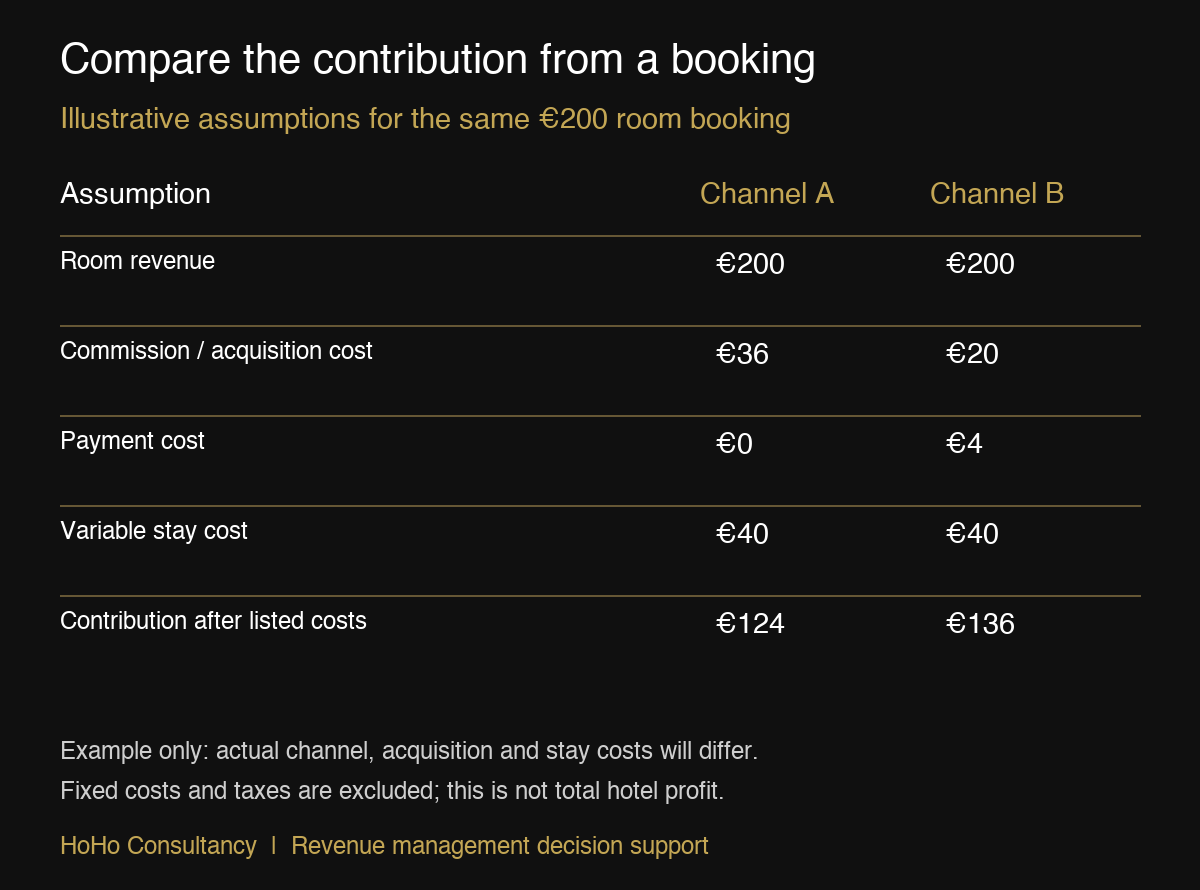
These are assumed values, not market rates or a recommendation for a particular channel. Fixed costs and taxes are excluded. Revenue management must also consider whether each channel brings additional demand, the booking conditions and the reliability of the cost estimates. The example shows a calculation method; it does not establish which channel is best for your hotel.
Direct booking work starts with the guest’s questions: what is included, which room suits the stay, what conditions apply and how easily can the reservation be completed? We review the journey from the hotel’s website to its booking engine and identify unclear information or unnecessary friction.
Revenue management also considers the cost of attracting that guest. Advertising, booking technology, payment processing and the work involved in handling enquiries can affect the commercial value of a direct reservation. Direct does not automatically mean free or more profitable. Comparisons need consistent definitions and a realistic view of attribution limits.
Priorities may include clearer room descriptions, transparent package inclusions, accurate availability or a better process for responding to enquiries. Where measurement is available, we agree which stage of the journey to assess and how to interpret the result. Relevant technical and reporting changes can connect with our hotel digitalisation and workflow support, with responsibilities agreed before implementation.
Direct bookings are the highest-margin channel—but only if your funnel is engineered for conversion. We optimize the full direct journey: rate presentation, value messaging, packages, add-ons, and booking engine friction points that kill sales. We align your direct offer with your Revenue Management & Distribution Strategy so it’s not just “cheaper,” but clearly better: flexible value, smart inclusions, and loyalty-style benefits that don’t destroy ADR.
A revenue management routine needs a clear owner and decisions that can be followed through. We agree a review format covering recent trading, the forward position, material changes and proposed actions. Each action should identify a responsible person, a review date and the evidence needed to judge progress.
Reports should distinguish room-performance measures from profitability. Occupancy, average daily rate and revenue per available room describe different aspects of room trading; they do not replace a review of distribution costs or the hotel’s broader financial results. Clear definitions help owners and managers discuss the same facts.
The handover includes reporting responsibilities, data limitations and the decisions that remain with management. Training focuses on how to interpret an unexpected result and when to investigate further. If ongoing administrative coordination is needed, our head office support can be considered separately. The scope should remain proportionate to the hotel’s size, systems and the time its team can realistically commit.
Effective revenue management connects pricing, booking demand, channel costs and the hotel’s ability to deliver its offer. We review these areas together so the team can explain its decisions, identify missing evidence and follow up on agreed actions.
Assume a hotel has 100 available rooms, sells 60 and records €7,200 in room revenue for one day. Occupancy is 60%, ADR is €120 and RevPAR is €72. These revenue management measures use different denominators, which is why their definitions matter.
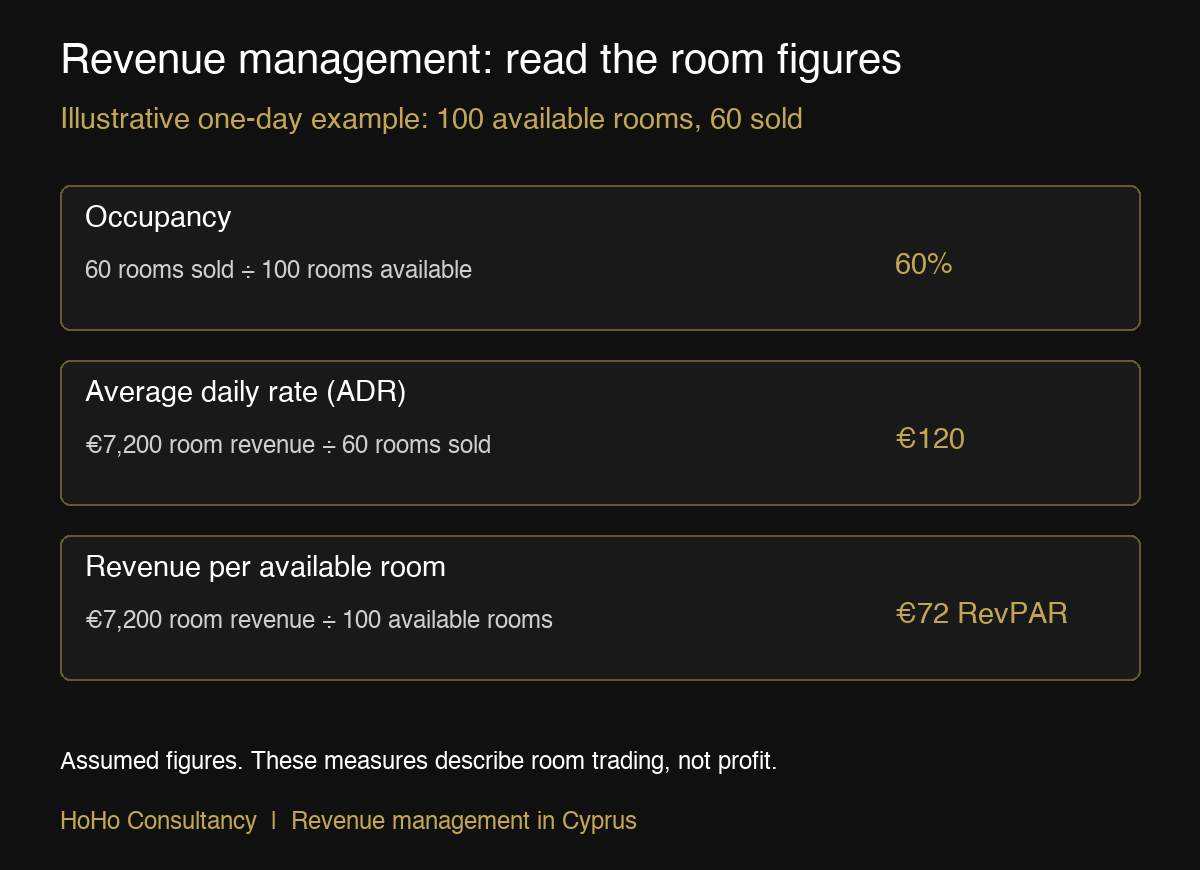
The figures are illustrative assumptions, not a property forecast or Cyprus benchmark. They describe room trading rather than profit. For the definitions used in revenue management reporting, consult the CoStar STR Benchmark glossary.
Establish consistent measures and identify missing information before changing the commercial plan.
Assess booking pace, cancellations and trading patterns to support the next pricing decision.
Define rate responsibilities, review triggers and a clear record of commercial decisions.
Understand the demand your property serves and the conditions attached to different bookings.
Review your offer, booking information and acquisition costs alongside intermediary channels.
Compare distribution costs and commercial value using consistent, transparent definitions.
Connect hotel pricing and channel choices with the information available for your property.
Review direct and intermediary channels using costs, demand and practical operating requirements.
Build a forecast and reporting routine with clear assumptions and follow-up responsibilities.
Practical answers about hotel revenue management, forecasting, distribution costs and the scope of support for your property in Cyprus.
Hotel revenue management connects room pricing, demand forecasts, availability and booking conditions. Distribution strategy considers how the property reaches guests through its own channels, online travel agencies and other partners. Together, they provide a framework for commercial decisions rather than a guarantee of higher revenue.
For a Cyprus hotel, the review should reflect its opening periods, location, guest mix and operating constraints. We establish what the available data can support, identify the decisions management needs to make and agree practical responsibilities. A useful outcome is a consistent process the team can maintain and explain to the owner.
The timing depends on the quality of your data, the booking cycle, system access and the changes agreed. Some issues, such as unclear rate-plan descriptions or inconsistent reporting definitions, may be addressed before a measurable change in trading can be assessed. Commercial results need an appropriate observation period.
We agree initial milestones and distinguish implementation progress from business outcomes. A completed pricing review is not proof of additional profit. Market conditions, seasonality and changes in the hotel’s offer can also affect results. The scope should specify when progress will be reviewed and which evidence will be available, without promising a fixed percentage uplift or a universal time to results.
We consider the measures together and keep their meanings distinct. Average daily rate (ADR) is room revenue divided by rooms sold. Occupancy compares rooms sold with rooms available. Revenue per available room (RevPAR) divides room revenue by available rooms. Use consistent periods and accounting definitions when comparing them.
These are room-performance measures, not complete profit measures. A higher ADR can coincide with fewer rooms sold, while higher room revenue can involve additional acquisition or operating costs. Our revenue management review connects the indicators with channel costs and the hotel’s wider financial reporting where reliable information is available. The CoStar/STR glossary provides industry definitions for reference.
We first establish the role OTAs play in your current demand and which costs are associated with those bookings. Reducing dependence is not simply a matter of closing availability: the hotel needs a credible way to reach and convert guests through other routes. Lost intermediary demand may not transfer to direct channels.
A practical plan can examine the website offer, enquiry handling, repeat-guest communication and the clarity of booking conditions. Any channel change should have a defined scope, monitoring responsibilities and a review date. We compare results using consistent assumptions and take relevant contractual requirements into account. No approach can guarantee that changing the channel mix will preserve every booking.
Forecasting starts with the bookings already held for future stay dates. We review booking pace, cancellations, stay patterns, available rooms and relevant historical comparisons. We also identify known changes in the property’s offer or opening schedule that make a simple comparison with last year misleading.
The forecast should state its preparation date and assumptions, with uncertainty made visible. Management can then discuss implications for staffing, inventory and commercial actions. We compare the eventual results with the forecast and investigate material differences. This makes the process useful for planning without treating an estimated occupancy figure as a commitment or assuming that past demand will repeat unchanged.
We can review the direct booking journey and agree improvements within the available scope. This includes how clearly the website explains rooms, packages and booking conditions, how the booking engine presents availability and how enquiries are handled. Technical changes should be tested before relying on them in campaigns.
Measurement also matters. Website visits alone do not establish qualified demand, and a recorded conversion may need checking against actual reservations. Acquisition and technology costs should be included when comparing direct bookings with other channels. Where the issue involves disconnected systems or manual follow-up, our digital workflows service may support the implementation. Results depend on demand, the offer and the changes the hotel adopts.
We start by identifying your property management system, channel manager, booking engine and reporting tools, together with the information each can provide. The scope depends on access, export quality and the configuration of your particular installation. We do not assume that every product supports the same integrations.
A review can begin with available reports where suitable, while recording gaps or manual work. Any proposed connection, automation or system replacement needs a separate assessment of requirements, costs, responsibilities and testing. Hotel staff should retain appropriate control over access and approvals. The aim is to make reliable use of the tools you have before recommending additional technology.
The service is intended for hotel owners, operators and commercial teams in Cyprus seeking clearer pricing, forecasting and distribution decisions. It may suit an independent hotel without a dedicated revenue manager or an established team that needs a focused review of its current process.
Before an assignment, we clarify the property’s size, operating periods, systems, data and management priorities. The work should be proportionate to the decisions the team can implement. A new development may first need an operating and positioning plan through our hotel development consultancy. A property facing broader operational difficulties may need turnaround support alongside the commercial review.
| Cookie | Duration | Description |
|---|---|---|
| cookielawinfo-checbox-analytics | 11 months | This cookie is set by GDPR Cookie Consent plugin. The cookie is used to store the user consent for the cookies in the category "Analytics". |
| cookielawinfo-checbox-functional | 11 months | The cookie is set by GDPR cookie consent to record the user consent for the cookies in the category "Functional". |
| cookielawinfo-checbox-others | 11 months | This cookie is set by GDPR Cookie Consent plugin. The cookie is used to store the user consent for the cookies in the category "Other. |
| cookielawinfo-checkbox-necessary | 11 months | This cookie is set by GDPR Cookie Consent plugin. The cookies is used to store the user consent for the cookies in the category "Necessary". |
| cookielawinfo-checkbox-performance | 11 months | This cookie is set by GDPR Cookie Consent plugin. The cookie is used to store the user consent for the cookies in the category "Performance". |
| viewed_cookie_policy | 11 months | The cookie is set by the GDPR Cookie Consent plugin and is used to store whether or not user has consented to the use of cookies. It does not store any personal data. |
Fields marked with * are required.