
Restaurant and hotel F&B consulting in Cyprus connects the concept guests buy with the costs and routines behind each service.

Our F&B consulting service supports hotel owners, operators and food and beverage managers in Cyprus who want a clearer view of restaurant, bar and breakfast performance. We review the connection between the guest offer, menu economics and the work required to deliver each service.
The starting point may be a busy restaurant with an unexplained margin, a breakfast operation with persistent waste, or an outlet preparing for a new season. A new opening needs a different approach: concept decisions, equipment constraints, supplier arrangements and team preparation must be considered together. For an opening or relaunch, we can connect this assignment with hotel development and pre-opening support.
We agree which outlets and decisions are in scope before requesting operational information. Useful inputs include current menus, recipe specifications, purchasing records, sales by item and daypart, staffing plans and recent stock counts. Missing or inconsistent records become part of the assessment rather than a reason to present estimates as established facts.
The resulting priorities should be usable by the people running the outlet. A chef needs workable production instructions; a supervisor needs clear service responsibilities; an owner needs reporting that explains material changes. Our F&B consulting work brings these perspectives into the same operating plan, with responsibilities and review dates agreed with management.

The first stage of F&B consulting establishes what the outlet is intended to offer and whom it serves. We review its role within the hotel, current menus, opening periods, available facilities and management’s priorities.
For an existing business, sales and guest feedback help frame the questions. A new concept requires explicit assumptions about demand, pricing and operating requirements. We distinguish these assumptions from evidence and identify where further research or professional input is needed.
The discussion covers the dining occasion, service style and relationship between hotel residents and external guests. We examine whether the intended experience fits the kitchen, seating, staffing and access arrangements. A concept that requires substantial changes should make those dependencies visible before implementation.
The output is a concise concept brief and an agreed scope for the next stages. Our F&B consulting approach uses this brief to guide menu and service decisions, so the team has a shared reference when considering new dishes, promotions or operating hours.
Our F&B consulting review examines the menu at item level, using available sales records and recipe specifications. We agree a consistent costing basis before comparing items, including portion size, ingredient yield and the treatment of tax in the figures.
A useful recipe record states quantities, expected output and the purchasing information used. Where these are uncertain, the team tests or updates them. Comparing theoretical recipe usage with actual consumption helps identify questions, but a variance needs investigation before its cause is assumed.
Menu decisions consider popularity, contribution, preparation demands and the item’s role in the guest offer. We discuss possible changes with the kitchen and service team, such as simplifying a garnish, reviewing a portion specification or adjusting how a dish is presented. Pricing decisions also need to reflect positioning and the wider cost structure.
F&B consulting then turns the analysis into a controlled test. We agree what changes, who approves it and which results will be reviewed. The objective is a menu the team can deliver and management can understand, with outcomes assessed using actual operating information.
This stage of F&B consulting reviews how products move from order to receipt, storage, preparation and sale. We identify the records and responsibilities needed to understand purchasing and consumption across the outlets in scope.
Ordering routines should reflect expected demand, available stock, delivery arrangements and storage constraints. Receiving checks help the team identify quantity or specification differences when goods arrive. Transfers between the kitchen, bar and other outlets need an agreed recording method if their costs are to be compared meaningfully.
We review stock-count practices and the treatment of waste, staff meals, complimentary items and other non-sale consumption. These categories make a difference when comparing recipe expectations with recorded usage. Counts and reports should use consistent units and periods, with material discrepancies assigned for follow-up.
The F&B consulting output can include purchasing responsibilities, count instructions and a simple variance-review template. Managers agree which changes to trial and how to check that they remain workable during service. The aim is dependable information and practical control, supported by the team’s actual routines.
F&B consulting examines the work behind the guest experience: preparation, ordering, production, handover and service. We discuss bottlenecks with the people doing the work and compare the proposed menu with the capacity of the kitchen and service team.
The review identifies where instructions or responsibilities are unclear. Examples include communicating an unavailable dish, confirming a modification, coordinating a delayed order or escalating a guest complaint. Procedures should explain the normal route and what staff should do when an exception occurs.
We agree practical instructions and training priorities with management, then test them during representative operating conditions. The team’s feedback helps distinguish a training issue from a process that needs redesign. A documented standard has value when staff can understand and apply it.
Where a broader procedure library is needed, this work can connect with our SOP development and staff training service. Food safety requirements must remain part of the operating framework, with qualified specialist input where required. Commercial F&B consulting does not replace the outlet’s food safety responsibilities.
This stage of F&B consulting looks at how guests discover, understand and choose the offer. We review menus, reservation information and communication between the outlet and other hotel departments.
A guest should be able to understand what is available, when it is served and what it costs. Staff recommendations should be accurate and relevant to the occasion. We discuss how to present options naturally, including the information the team needs before recommending dishes or drinks.
For a hotel outlet, reception and guest communications can help make the dining offer visible. For external guests, practical information such as location, access and booking arrangements also matters. Proposed promotions should fit the concept and be assessed against the capacity needed to deliver them.
Our F&B consulting work defines a manageable test and a way to assess it. Covers and average spend are considered alongside costs, sales mix and guest feedback. If digital handovers or booking routines need attention, we can connect the project with digital workflows for hospitality.
The final stage of F&B consulting gives management a structured way to review results and follow up on decisions. We agree the measures needed for the outlet, their sources and how frequently they can be reviewed reliably.
Relevant information may include sales by daypart, covers, average spend, item mix, food and beverage costs, labour allocation and recorded waste. Definitions matter: figures from different systems or periods should not be compared as though they describe the same activity. Reporting should identify incomplete information and explain any estimates.
A review meeting should focus on material changes, plausible explanations and the next action. Each action needs an owner and a review date. This could mean checking a recipe specification, investigating a stock difference or observing a service handover before changing the procedure.
F&B consulting closes with agreed responsibilities and documents that managers can maintain. Where the owner needs ongoing consolidated reporting, our head office support service can be considered separately. The scope and frequency of continued involvement are agreed with the client.
Our F&B consulting work connects the guest offer with the information and routines needed to manage it. The priorities below are adapted to your outlet, available records and operating team.
Review recipe costs, selling prices and contribution by menu item.
Assess which guests and occasions your outlet is designed to serve.
Build relevant recommendations and clearly priced options into service.
Record waste and compare purchasing, preparation and stock usage.
Clarify the handovers and standards needed for a reliable dining experience.
Connect sales and operating costs in a review managers can act on.
Connect menu decisions with recipe costs, guest demand and kitchen capacity.
Give managers practical routines for purchasing, preparation and service reviews.
Assess the outlet’s positioning within its hotel and local Cyprus market.
Practical answers about F&B consulting for hotels and restaurants. For official background on food hygiene, see the European Commission’s food hygiene guidance platform. Apply the relevant requirements with appropriate professional support for your operation.
F&B consulting can cover concept positioning, recipe costing, menu analysis, purchasing routines, service procedures and management reporting. The assignment is agreed around the outlets and decisions that need attention.
We begin by reviewing the available information and discussing the operating context with management. The deliverables may include a concept brief, a menu review, revised procedures or an action plan with named responsibilities. Recommendations are connected to the team’s capacity to implement them. The scope of any continued operational support is agreed separately.
Our F&B consulting service is intended for hotel owners, operators and food and beverage managers in Cyprus. It can support an established restaurant, bar or breakfast operation, as well as an outlet preparing to open or relaunch.
The relevant starting question may be unexplained costs, a menu that is difficult to produce, weak coordination between kitchen and service, or a concept that needs clearer positioning. We discuss the issue before recommending the scope. If the challenge extends across the hotel, we can also consider turnaround and interim management support.
We review where the operating model can be improved while preserving the intended guest experience. F&B consulting considers menu complexity, recipe specifications, purchasing, waste and service organisation together.
A lower purchase price is not automatically a better decision if it changes yield, quality or preparation requirements. Similarly, a shorter menu should still meet the needs of the intended guests. Proposed changes are discussed with management and tested in operation. Their effect should be assessed using actual costs, sales and service feedback, rather than promising a fixed margin increase before the underlying information has been reviewed.
Menu engineering is an item-level review that connects sales popularity with contribution and operating requirements. In F&B consulting, we use it to identify questions and decisions rather than treating a ranking of dishes as a complete answer.
For example, a popular item may generate a modest contribution per sale but play an important role in the overall offer. Another item may look attractive on recipe cost while creating preparation bottlenecks. We review the costing assumptions, sales mix and kitchen implications before recommending a change. Management then tests the decision and monitors the outcome.
The sequence below helps an outlet manager connect recipe records with a decision that can be tested during service. Use the same reporting period, portion specification and tax treatment when comparing items.
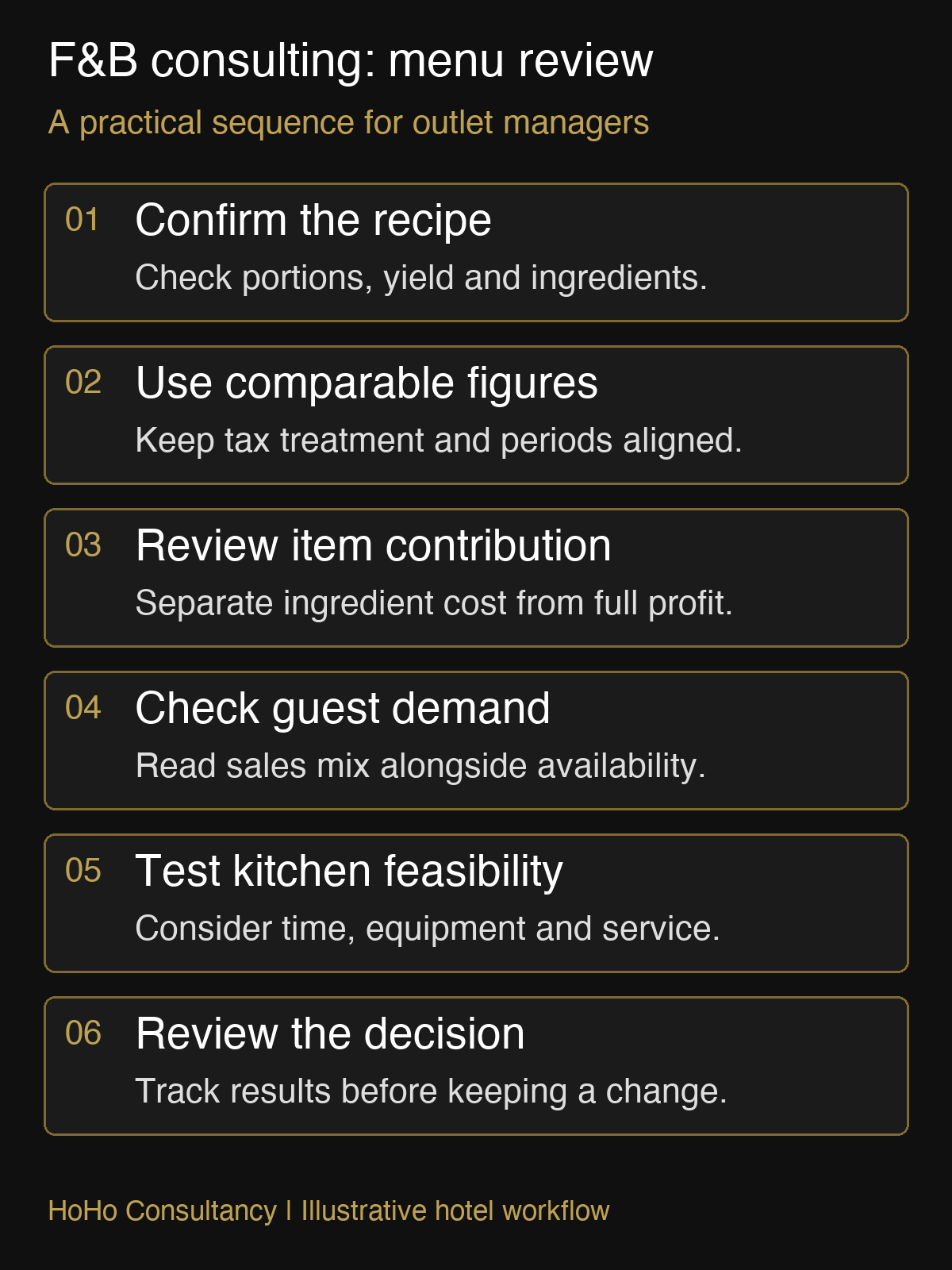
Assume an item sells for €20 excluding VAT and its recipe ingredients cost €6 on a comparable basis. The difference is €14 per sale before labour, energy, other operating expenses and any costs excluded from the recipe. These are illustrative assumptions, not a Cyprus market benchmark or a forecast for your restaurant.
If the kitchen sells 50 portions under those assumptions, the difference totals €700. That amount cannot be described as the outlet’s profit: actual staffing, waste, discounts and other expenses still need to be considered. The menu review should also check whether the item slows service, requires special equipment or relies on ingredients used nowhere else.
Before changing the dish, agree one test, a responsible manager and a review period. Record availability and guest feedback alongside sales so that an out-of-stock item is not mistaken for weak demand. Retain, adjust or reverse the change based on the evidence. This is how F&B consulting turns an item-level calculation into an operating decision.
Yes. F&B consulting can review how hotel residents and external guests discover and use the outlet. This includes menu information, booking arrangements, opening hours, staff recommendations and coordination with reception.
We agree which opportunity to test and how success will be assessed. The review should include costs and operating capacity as well as covers and spend. A promotion that attracts additional guests may require more labour or ingredients, so revenue alone is not a sufficient measure. The aim is to build an offer that is understandable, deliverable and appropriate for the guests you want to serve.
Procedures and training can form part of the agreed F&B consulting assignment. We work with management to clarify preparation routines, stock records, service handovers, opening and closing tasks, and escalation routes.
Training should include practical application and a way for supervisors to check understanding. Where an instruction is difficult to follow, the team should be able to raise it for review. Our SOP development and staff training service provides a broader framework for this work. Specialist food safety requirements and local obligations must be addressed by appropriately qualified people within the operating arrangements.
The measures depend on the outlet and the reliability of the available records. F&B consulting may review covers, average spend, sales by daypart, item mix, food and beverage costs, labour allocation and recorded waste.
Each measure needs a clear definition and reporting period. For example, package meals and complimentary items need consistent treatment if average spend is to be compared over time. Managers should also understand how shared costs are allocated. We agree a focused review with responsibility for investigating material differences, rather than producing a large dashboard without a clear purpose.
Contact HoHo Consultancy with a short description of your property, the outlets involved and the main decision or operating problem you want to address. We can then discuss whether an F&B consulting assignment fits your needs.
For the initial conversation, a current menu and a summary of the challenge are useful. Detailed operational records can be agreed once the scope and appropriate handling arrangements are clear. We confirm the proposed work, deliverables and responsibilities before the assignment starts, so the team knows what information and participation will be needed.
| Cookie | Duration | Description |
|---|---|---|
| cookielawinfo-checbox-analytics | 11 months | This cookie is set by GDPR Cookie Consent plugin. The cookie is used to store the user consent for the cookies in the category "Analytics". |
| cookielawinfo-checbox-functional | 11 months | The cookie is set by GDPR cookie consent to record the user consent for the cookies in the category "Functional". |
| cookielawinfo-checbox-others | 11 months | This cookie is set by GDPR Cookie Consent plugin. The cookie is used to store the user consent for the cookies in the category "Other. |
| cookielawinfo-checkbox-necessary | 11 months | This cookie is set by GDPR Cookie Consent plugin. The cookies is used to store the user consent for the cookies in the category "Necessary". |
| cookielawinfo-checkbox-performance | 11 months | This cookie is set by GDPR Cookie Consent plugin. The cookie is used to store the user consent for the cookies in the category "Performance". |
| viewed_cookie_policy | 11 months | The cookie is set by the GDPR Cookie Consent plugin and is used to store whether or not user has consented to the use of cookies. It does not store any personal data. |
Fields marked with * are required.